
Convex Mirror Model Comparison: YD-OC60 vs. YD-OC75 vs. YD-OC100 vs. YD-OC120 for Outdoor Coverage
Convex Mirror Model Comparison: YD-OC60 vs. YD-OC75 vs. YD-OC100 vs. YD-OC120 for Outdoor Coverage
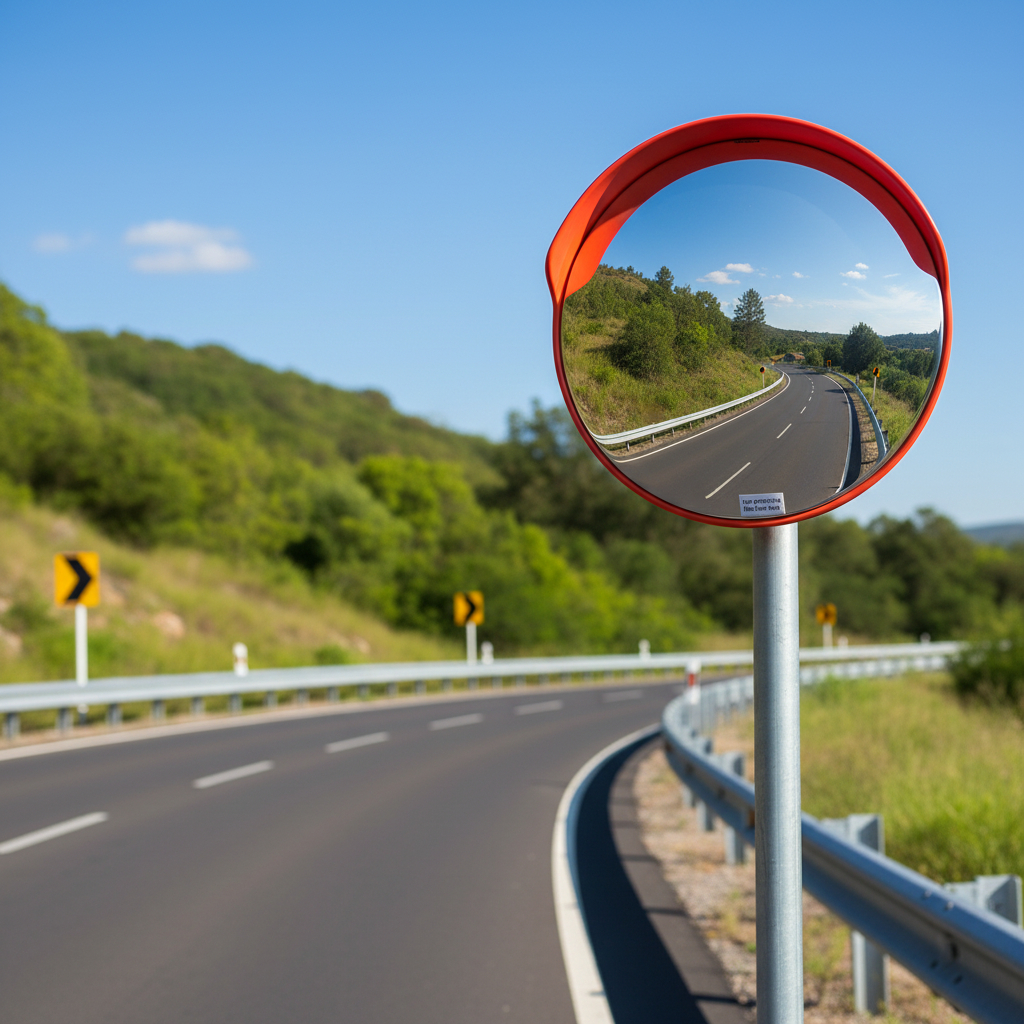
An outdoor convex mirror covers one job: it shows a driver what the sight line hides. Diameter decides how far that coverage reaches.
Mnsd's YD-OC series places four outdoor polycarbonate convex mirrors on one construction platform: YD-OC60, YD-OC75, YD-OC100 and YD-OC120. Mnsd is the brand of Tiantai Yuanda Traffic Device Co., Ltd., a road safety equipment manufacturer based in Tiantai, Zhejiang, China, founded in 2007, whose product portfolio includes convex mirrors, warning posts, rising bollards, speed humps and traffic lights.
All four YD-OC models share the same materials and the same outdoor rating. Each uses an impact-resistant polycarbonate (PC) lens with a vacuum aluminum coated mirror surface, a high-impact ABS backing in bright orange for high visibility, and a heavy-duty galvanized steel mounting bracket. Every model is rated IP65 for outdoor use, operates between -30°C and +80°C, uses UV-stabilized PC & ABS with Grade 8 UV resistance, and is documented as vandal-resistant with self-recovery behaviour and Level 10 wind load resistance.
What changes across the four models is diameter — and diameter is what sets visual range. That single variable decides whether a mirror is the right answer for a T-junction, a parking ramp, a warehouse aisle crossing or a logistics park exit.
Short answer: match the model to the distance a driver must read traffic from. YD-OC60 (600 mm, 130°+ wide angle) covers 15–18 m; YD-OC75 (750 mm, 180° angle of view) covers 20–25 m; YD-OC100 (1000 mm, 130°+ wide angle) covers 30–35 m; YD-OC120 (1200 mm, 130°+ wide angle) covers 35–45 m. When two models both appear to fit, decide on approach speed, sight-line obstruction and mounting height — not on unit price alone.
1. Problem Definition: Why Blind-Spot Coverage Fails Outdoors
Most outdoor convex mirror problems at the site level are sizing problems, not material problems. Four patterns repeat.
- The mirror is too small for the approach. A 600 mm mirror and a 1200 mm mirror can look similar in a catalogue photograph, but they serve different distances — 15–18 m versus 35–45 m. Where approach speeds are higher or the junction is wide, a small mirror returns a reflection the driver cannot resolve in time to react.
- The mirror is too large for the structure and the sight line. Over-sizing increases panel weight and wind-facing area, and can push the installer to mount the unit higher than the intended eye line. Bigger is not automatically safer.
- The mounting surface is not checked before ordering. All four models are designed for wall or pole mounting and fit poles of 60 mm / 75 mm diameter. A site with no suitable pole or wall face adds installation scope that the mirror selection alone does not solve.
- The outdoor environment is not matched to the product. Frost, sustained UV exposure and wind load are the three conditions that age a roadside mirror fastest. These are addressed at the specification level: IP65 weatherproof rating, an operating temperature range of -30°C to +80°C, UV-stabilized PC & ABS with Grade 8 UV resistance, and Level 10 wind load resistance.
2. Industry Background: Outdoor Convex Mirrors in 2026
The convex mirror category is a small but structurally important part of the wider safety equipment market, and its demand profile explains why four sizes exist instead of one.
- The global convex mirror market was valued at approximately USD 1.04 billion in 2025 and is projected to reach USD 1.73 billion by 2034 (Dataintelo).
- Asia Pacific held the largest regional revenue share in 2025, at 42.5% (Dataintelo).
- Traffic and safety applications represent the largest application segment, at 38.2% of the market (Dataintelo).
- Global trade in unframed mirrors declined 9.2% in 2023 compared with 2022, a signal of supply-chain shifts and demand softness in general mirror products (Business Research Insights). The practical implication for buyers is that stocking depth and production continuity differ sharply between general mirror traders and dedicated road safety manufacturers.
A commonly cited benchmark for outdoor polycarbonate convex mirrors is a 180° viewing angle with a visual range of 20–25 m. That benchmark corresponds to the mid-size model in this series, which is why a four-model range matters: sites below and above the benchmark would otherwise be over- or under-served by a single specification.
Mnsd's application documentation for this product family concentrates on traffic facilities, road safety and property management, with project use in road safety hazard mitigation, parking lot installation and business park traffic optimization. India is one documented market where outdoor intersections, underground garage corners and T-junctions are typical installation points.
3. Detailed Solution: One Platform, Four Diameters
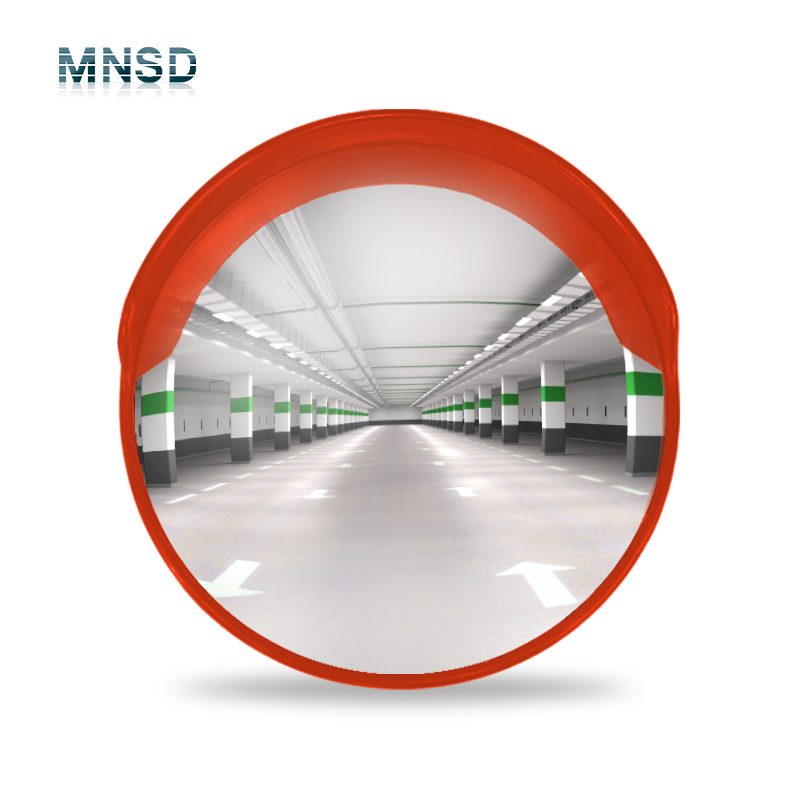
The YD-OC outdoor polycarbonate convex mirror: orange high-impact ABS backing, hooded weatherproof construction, galvanized steel bracket.
Because the four models share one construction platform, the buying decision narrows to diameter, mounting and configuration options. The table below lists the specification that applies to the entire YD-OC60 / YD-OC75 / YD-OC100 / YD-OC120 group.
| Specification area | Documented value |
|---|---|
| Mirror material | Impact-resistant polycarbonate (PC) |
| Surface treatment | Vacuum aluminum coating; optional anti-scratch hard coating available |
| Lens thickness | 0.6–1 mm, customizable |
| Curvature radius | R2200 – R3000 |
| View angle | 130°+ wide-angle vision (wide-angle panoramic mirror) |
| Weatherproof rating | IP65, for outdoor use |
| Operating temperature | -30°C to +80°C |
| UV protection | UV-stabilized PC & ABS, Grade 8 UV resistance, 3–5 years lifespan |
| Backing and structure | High-impact ABS plastic backing, bright orange for high visibility; 2.0 mm back plate wall thickness |
| Mounting | Wall or pole mounting; heavy-duty galvanized steel bracket; fits 60 mm / 75 mm poles |
| Impact behaviour | Vandal-resistant and self-recovery |
| Wind resistance | Level 10 wind load resistant |
| Optional rim treatment | Engineering grade reflective tape on rim |
Because curvature radius and lens thickness are common across the range, visual range in this series is driven by panel diameter. That is a useful planning fact: a buyer can step up or down a size for coverage reasons without changing coating, base material or mounting hardware.
YD-OC60 — 600 mm, 130°+ wide angle, 15–18 m visual range
The YD-OC60 is the compact model: an outdoor polycarbonate convex mirror with a 600 mm overall diameter, a weatherproof hooded construction and a 2.0 mm back plate. Its 15–18 m visual range fits short, contained blind spots — an internal aisle crossing, a service corridor corner, a small parking ramp where traffic is slow and turning. It is also the lightest panel in the group, which is relevant on lighter mounting structures.
YD-OC75 — 750 mm, 180° angle of view, 20–25 m visual range
The YD-OC75 is documented with an angle of view of 180° and a wide-angle vision of over 130°, and it carries a 750 mm polycarbonate panel on the same galvanized steel bracket and bright orange ABS backing. Its 20–25 m visual range matches the widely used benchmark for outdoor polycarbonate convex mirrors, which makes it the natural default for community intersections, T-junctions and mid-size parking decks where the approach is moderate rather than high speed.
YD-OC100 — 1000 mm, 130°+ wide angle, 30–35 m visual range
The YD-OC100 uses a 1000 mm impact-resistant polycarbonate panel with a 130°+ view angle, an IP65 weatherproof rating, a -30°C to +80°C operating range, and the same Grade 8 UV-resistant PC & ABS construction. The step up to 30–35 m of visual range is what makes it suitable for wide junctions, factory crossings and main warehouse aisles where vehicles approach from further away or at higher speed.
YD-OC120 — 1200 mm, 130°+ wide angle, 35–45 m visual range
The YD-OC120 is the largest model in the comparison: a 1200 mm convex mirror with a 130°+ wide-angle field of view, a vacuum aluminum coated surface, an IP65 rating, and a documented visual range of 35–45 m. It is intended for the largest outdoor blind spots — logistics park exits, yard-to-road transitions, port and dock intersections, and highway ramp merges where a driver needs warning at long range.
One smaller model sits outside this comparison but is worth noting for scope control: the YD-OC45, a 450 mm outdoor polycarbonate convex mirror with a 10–12 m visual range. Buyers who find themselves considering the YD-OC120 for a space that only needs 15 m of coverage are usually over-specifying.
4. Step-by-Step: Matching a Model to Your Site
- Measure the blind spot, not the mirror. Identify exactly where the sight line breaks — a T-junction, an aisle crossing, a ramp exit, a gate — and note the distance from which an approaching driver must see the conflicting traffic.
- Convert that distance into a visual range requirement. The four documented ranges are 15–18 m (YD-OC60), 20–25 m (YD-OC75), 30–35 m (YD-OC100) and 35–45 m (YD-OC120).
- Select the smallest model that meets the requirement. Step up only when the required distance, approach speed or junction width genuinely exceeds the smaller model's range. This keeps panel weight and wind-facing area proportionate to the structure.
- Confirm the mounting surface and hardware. All four models are designed for wall or pole mounting with a heavy-duty galvanized steel bracket, and fit 60 mm / 75 mm poles. Confirm a suitable pole or wall face exists before specifying.
- Plan the mounting height and orientation. The mirror must sit where a normal driver eye line catches it before the conflict point, angled so that the reflected traffic occupies the centre of the field of view.
- Check the exposure profile against the specification. Confirm the site falls inside an IP65 outdoor rating, a -30°C to +80°C operating temperature range, Grade 8 UV resistance and Level 10 wind load resistance.
- Confirm configuration options. Lens thickness from 0.6–1 mm is customizable, an anti-scratch hard coating is optional, and engineering grade reflective rim tape is optional. These choices support OEM and ODM customization requests.
- Validate with a sample before volume ordering. A physical unit confirms size, reflection clarity and bracket fit on the actual mounting structure — the three things a specification sheet cannot settle.
5. Use Cases: Road Traffic, Parking Garages, Warehouses and Logistics Parks
Mnsd's documented application list for this product family spans road traffic, residential quarters, parking garages, factories and warehouses, logistics parks, shopping malls, supermarkets, schools, hospitals, gas stations, construction sites, office parks, ports and docks, bus stations, industrial zones, community intersections, rural roads and highway ramps. The diameter split below reflects how the models are normally paired with those locations.
- Road traffic, rural roads and highway ramps: the wider approach distances point to YD-OC100 and YD-OC120.
- Parking garages and underground levels: ramp exits, corner columns and level transitions favour YD-OC60 and YD-OC75, where space is tight and speeds are low.
- Factories and warehouses: aisle intersections and racking corners typically use YD-OC60, YD-OC75 or YD-OC100, depending on aisle width and lift-truck traffic.
- Logistics parks, loading docks, ports and industrial zones: yard exits and dock approaches call for YD-OC100 and YD-OC120.
- Residential quarters and community intersections: YD-OC75 is the usual fit for driveway and lane junctions.
In documented projects, these mirrors are installed under road safety hazard mitigation, parking lot installation and business park traffic optimization programmes within the traffic facilities, road safety and property management sector — typically at outdoor intersections, underground garage corners and T-junctions where the blind spot is significant and the requirement is a UV-resistant, impact-resistant mirror with high clarity and strong weather resistance.
6. Comparison Table: YD-OC60 vs. YD-OC75 vs. YD-OC100 vs. YD-OC120
| Model | Diameter | View angle | Visual range | Typical outdoor use |
|---|---|---|---|---|
| YD-OC60 | 600 mm | 130°+ wide angle | 15–18 m | Warehouse aisle crossings, garage corners, short slow-speed approaches |
| YD-OC75 | 750 mm | 180° angle of view (>130° wide angle) | 20–25 m | Community intersections, T-junctions, mid-size parking decks |
| YD-OC100 | 1000 mm | 130°+ wide angle | 30–35 m | Wide junctions, factory crossings, warehouse main aisles |
| YD-OC120 | 1200 mm | 130°+ wide angle | 35–45 m | Logistics park exits, yard-to-road transitions, ports and highway ramps |
| Shared feature | Value |
|---|---|
| Outdoor weatherproofing | IP65 |
| Operating temperature | -30°C to +80°C |
| UV performance | UV-stabilized PC & ABS, Grade 8 UV resistance, 3–5 years lifespan |
| Mounting | Wall or pole mount, heavy-duty galvanized steel bracket, 60 mm / 75 mm poles |
| Construction | Impact-resistant PC lens, vacuum aluminum coating, high-impact bright orange ABS backing, 2.0 mm back plate |
| Durability ratings | Vandal-resistant and self-recovery; Level 10 wind load resistant |
7. FAQ: Choosing Between the Four Models
Do the YD-OC60, YD-OC75, YD-OC100 and YD-OC120 meet outdoor weatherproofing and durability requirements?
Yes — all four models carry the same outdoor specification. Each is rated IP65 for outdoor use, operates between -30°C and +80°C, uses UV-stabilized PC & ABS with Grade 8 UV resistance and a 3–5 year lifespan, is vandal-resistant with self-recovery behaviour, and is rated Level 10 wind load resistant. The mirror body is impact-resistant polycarbonate with a vacuum aluminum coated surface and a high-impact ABS backing. For fixed roadside and in-plant installations, buyers should confirm the applicable regulatory requirement with the local project authority; FMVSS No. 111 in the USA, for example, governs supplementary mirrors installed in passenger cars rather than stationary site mirrors.
How do I choose between the 600 mm, 750 mm, 1000 mm and 1200 mm models?
Choose by visual range. The YD-OC60 (600 mm) covers 15–18 m, the YD-OC75 (750 mm) covers 20–25 m with a 180° angle of view, the YD-OC100 (1000 mm) covers 30–35 m, and the YD-OC120 (1200 mm) covers 35–45 m. All four deliver a wide-angle vision of over 130° and all mount on walls or on 60 mm / 75 mm poles with a heavy-duty galvanized steel bracket. Select the smallest model that meets the distance a driver must see from, then confirm mounting height and orientation on site.
What drives the cost difference between the four models?
The dominant cost driver is diameter, and therefore the amount of polycarbonate, ABS backing and packaging per unit: the YD-OC60 at 600 mm sits at one end of the range and the YD-OC120 at 1200 mm at the other. Configuration choices also move the quotation — customizable lens thickness from 0.6–1 mm, optional anti-scratch hard coating, and optional engineering grade reflective rim tape on the mirror edge. Because these variables combine differently by order, Mnsd quotes model by model rather than publishing list prices; buyers can request a quotation for the exact model, configuration and quantity at information listed below.
Can I test a model before ordering in volume?
Yes. All four models are produced on the same platform, and Mnsd offers OEM and ODM customization services, so a buyer can validate a unit before committing to volume. A sample confirms the three things a datasheet cannot: that the diameter matches the site's coverage gap, that the reflection is readable from the intended driver eye line, and that the galvanized steel bracket fits the mounting structure. Sample requests, catalogues and specifications can be directed to Mnsd at info@mnsdtraffic.com or via WhatsApp at +86 184-5813-7305.
What production capacity supports lead time on these models?
Tiantai Yuanda Traffic Device Co., Ltd. operates from a 40,000 m² manufacturing facility with approximately 300 employees, a 15-engineer R&D team, and an annual production capacity of 120,000,000 units across its traffic safety portfolio, which includes convex mirrors, warning posts, rising bollards, speed humps and traffic lights. Export business accounts for 50% of total sales, with main markets in Asia, Europe and the USA. Lead time is confirmed per order, because it depends on the model mix, the configuration options selected and the order quantity — reserve schedule discussion for the quotation stage rather than assuming a single fixed lead time across all four sizes.
Conclusion: A Sizing Decision First, a Sourcing Decision Second
Across the YD-OC60, YD-OC75, YD-OC100 and YD-OC120, the buying decision reduces to one number: the visual range the site actually requires. IP65 weatherproofing, a -30°C to +80°C operating range, Grade 8 UV-resistant PC & ABS construction, a 2.0 mm back plate and a heavy-duty galvanized steel bracket are common to all four, so material quality and outdoor durability are not the variables. Diameter is. A 600 mm panel at 15–18 m, a 750 mm panel at 20–25 m with a 180° angle of view, a 1000 mm panel at 30–35 m, and a 1200 mm panel at 35–45 m each solve a different geometry.
The practical sequence is therefore short: measure the blind spot, convert it into a required visual range, choose the smallest model that covers it, confirm wall or pole mounting on a 60 mm / 75 mm pole, and validate the choice with a sample before volume ordering. Buyers who follow that order avoid the two most common outdoor coverage failures — a mirror that is too small to act on, and a mirror that is larger and heavier than the site ever needed.

Convex mirror production runs on the same 40,000 m² facility as the rest of the Mnsd traffic safety portfolio.
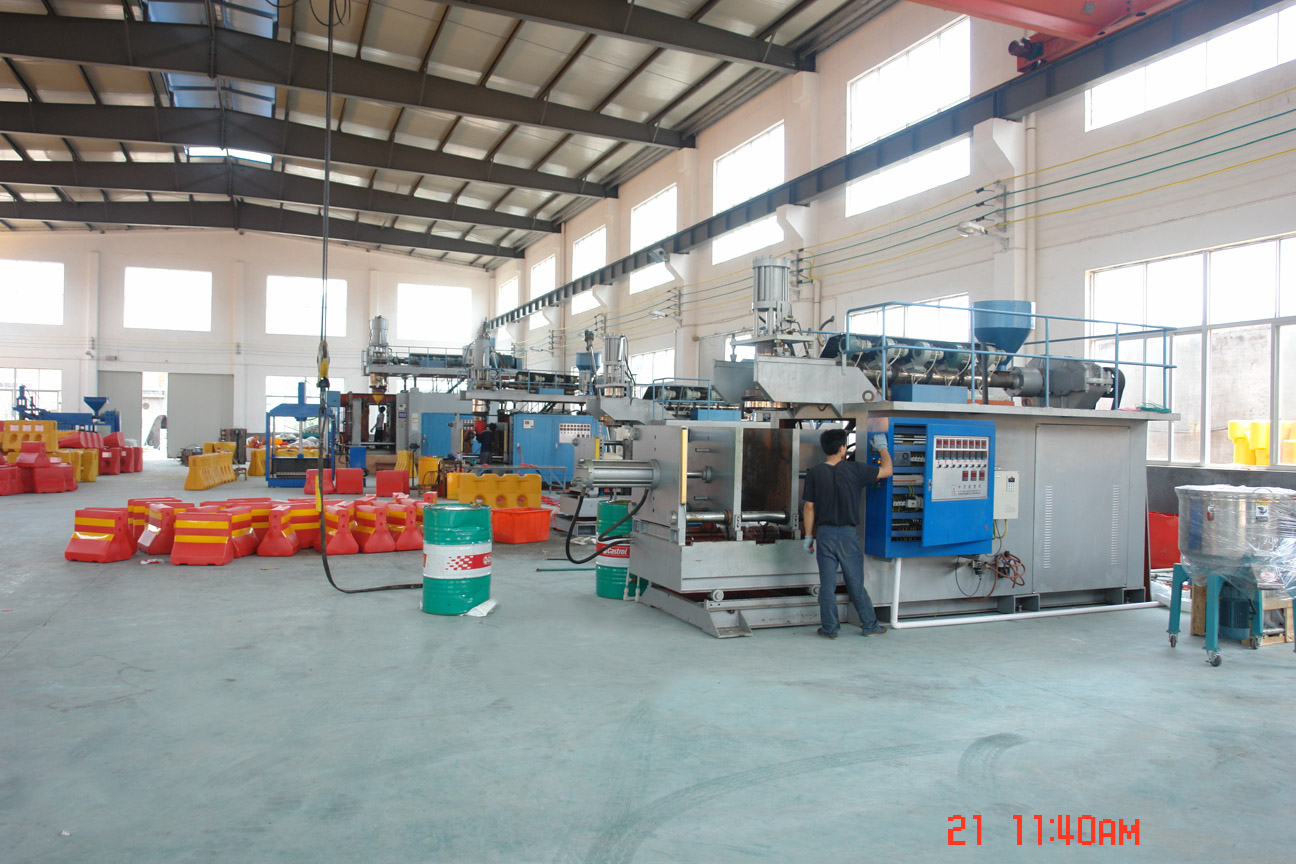
Polycarbonate and ABS components are produced in-house, which is what keeps UV resistance and impact behaviour consistent from size to size.
Next step: if you are specifying outdoor convex mirrors for a road, parking, warehouse or logistics site, send the site type, required coverage distance and mounting arrangement, and Mnsd will recommend the matching YD-OC model. Samples, quotations and the full product catalogue are available on request.
Email: info@mnsdtraffic.com | Tel / WhatsApp: +86 184-5813-7305 | Website: www.mnsdtraffic.com | Blog: blog.mnsdtraffic.com
Download the full product catalogue: Mnsd Traffic Safety Product Brochure (PDF)
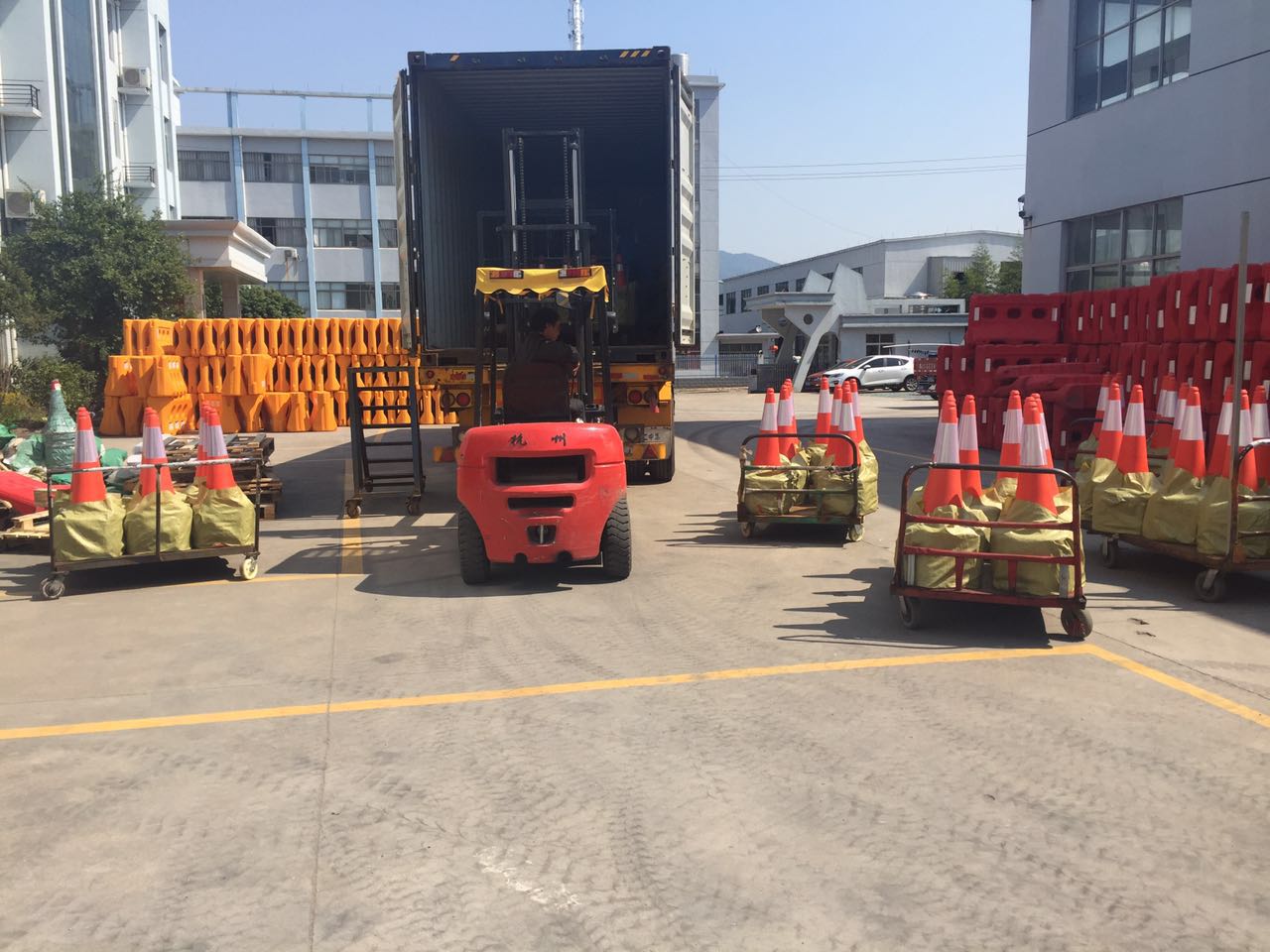
Export orders represent 50% of total sales, with main markets in Asia, Europe and the USA.
Have Questions or Need More Details?
Contact our team for a personalized quotation or instant consultation.
Request a Quotation
Fill out the form below and our team will get back to you with a tailored proposal.
WhatsApp Direct Chat
Prefer to chat in real-time? Message us on WhatsApp for instant assistance & quick answers.
- Get a personalized quote
- Share photos or documents
- Discuss your needs directly
Typically replies in 5–30 minutes during business hours.