
YD-OC75 vs. YD-OC100 Convex Mirrors: A Head-to-Head Guide for Industrial Blind Spots
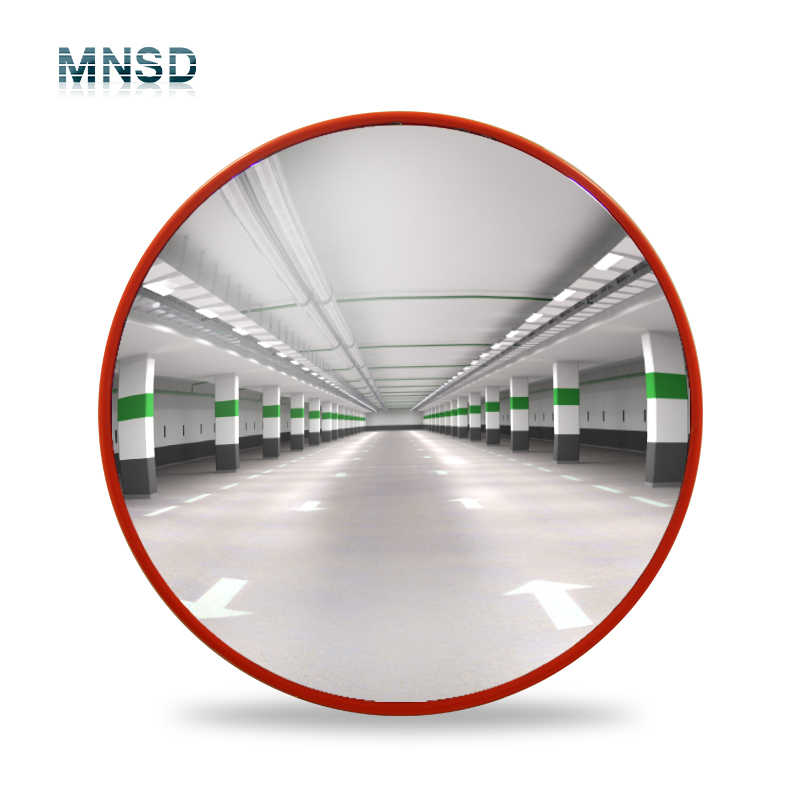
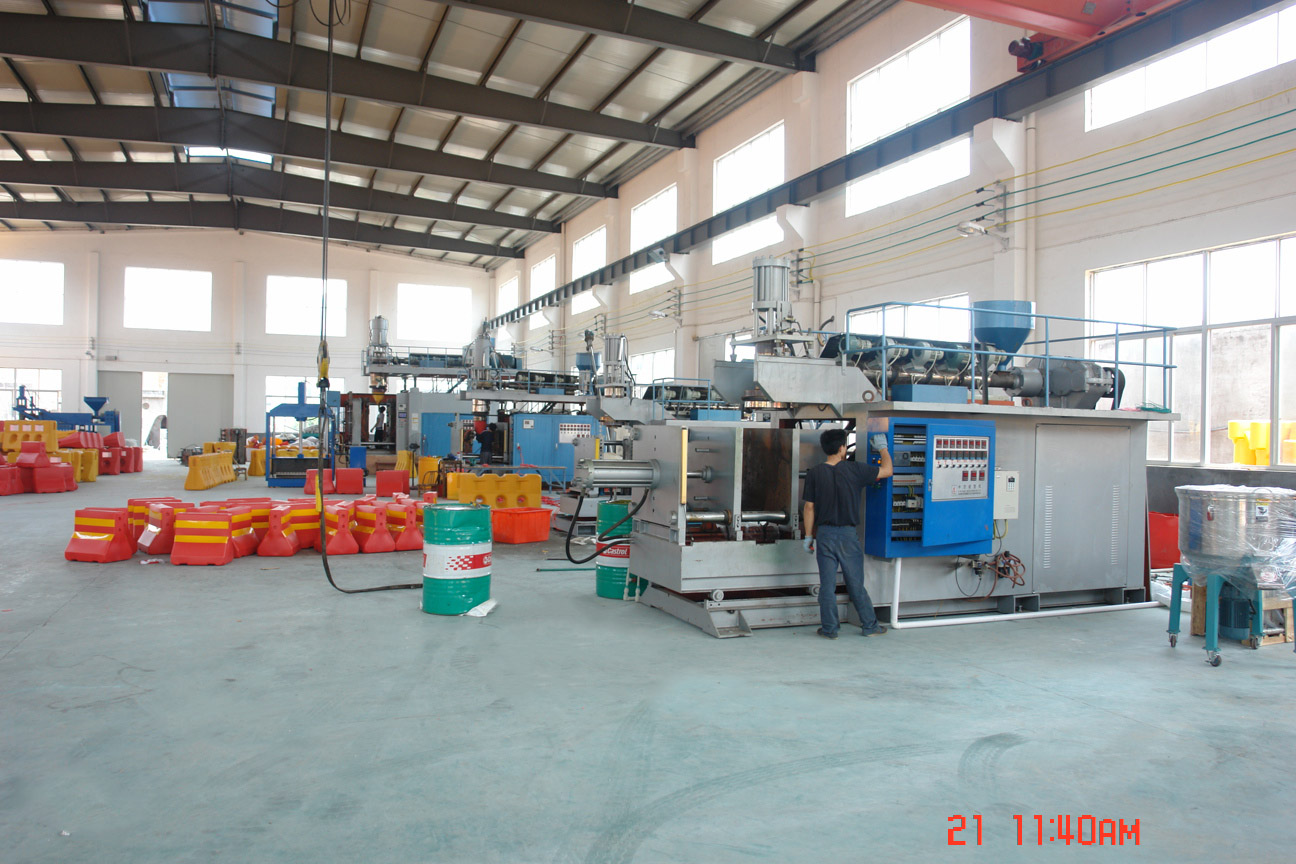
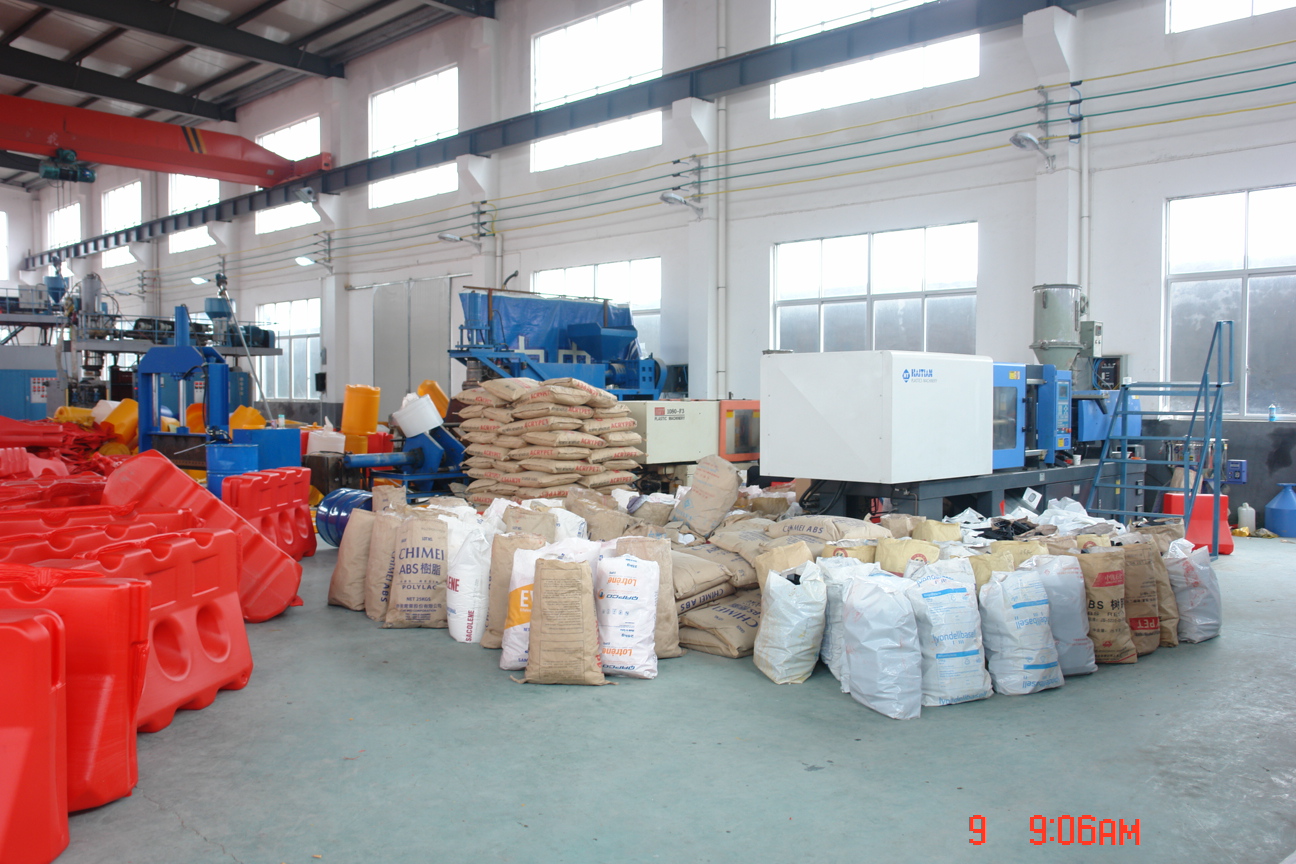
Two outdoor polycarbonate convex mirrors carry most industrial blind-spot projects: the 750 mm YD-OC75 and the 1000 mm YD-OC100. Both are produced by Mnsd (Tiantai Yuanda Traffic Device Co., Ltd), a road safety equipment manufacturer located in Tiantai, Zhejiang, China. Both use impact-resistant polycarbonate lenses, bright orange ABS backing, IP65 weatherproofing and galvanized steel brackets.
Because the build is shared, the decision is not about manufacturing quality. It is about geometry: how far the reflected image has to travel, and how wide it has to spread when it arrives. Get that calculation wrong and a perfectly built mirror still leaves part of the corner unreadable.
Direct answer: Specify the YD-OC75 (750 mm, 20–25 m visual range, 180° view angle) for close, wide crossings such as warehouse aisle intersections, loading dock doors and parking garage ramps. Specify the YD-OC100 (1000 mm, 30–35 m visual range, 130°+ view angle) for long approach lanes such as yard junctions, perimeter roads and logistics park gates. Where a single site contains both geometries, specify both models rather than forcing one diameter across the whole facility.
Problem definition: why blind-spot mirrors fail in industrial sites
Blind-spot mirrors fail for two opposite reasons, and from the buyer's desk both failures look identical — the corner is still dangerous after installation.
Undersizing. A mirror that is too small for the distance compresses the reflected image until vehicles and pedestrians become silhouettes. A 750 mm convex mirror placed at a junction where the optical path runs 30 m will show the activity, but not the detail a forklift operator needs in order to decide whether to enter the aisle.
Oversizing. A large mirror mounted close to the intersection returns a bright but narrow field. The 1000 mm model is specified at 130°+ of coverage; the 750 mm model is specified at 180°. At a tight warehouse corner, that 180° spread is what holds the pedestrian standing at the edge of the rack end inside the reflected image.
Site signals that the diameter is wrong usually appear within weeks of installation:
- Near-misses concentrate at one specific corner even though a mirror is fitted there.
- Drivers stop, lean forward or open the cab door to look around the mirror instead of using it.
- The mirror works at night or in rain but not in low-angle daylight, because the placement has not been aligned to the driver's eye line.
- Two adjacent locations on the same site perform very differently, which usually means one diameter has been applied to two different geometries.
The practical conclusion is that mirror sizing is a measurement task, not a catalogue task. The rest of this guide converts the YD-OC75 and YD-OC100 specifications into that measurement.
Industry background: passive optics inside a growing safety market
Convex mirrors remain a mainstream industrial safety purchase rather than a legacy item. In the 2026 market research reviewed for this comparison, the global convex mirror market was valued at USD 1.04 billion in 2025 and is forecast to reach USD 1.73 billion by 2034, a compound annual growth rate of 5.8% (Dataintelo, Convex Mirror Market Size, Share & Forecast Report 2025 to 2034). Asia Pacific accounted for 42.5% of global revenue in 2025, which is consistent with the region's concentration of polycarbonate mirror manufacturing.
Growth has not changed the underlying physics. Compared with electronic monitoring systems, a convex mirror offers a passive safety design, no power requirement, a wide viewing angle, a lower upfront cost and minimal maintenance, and it suits a broad range of applications (Mnsd product documentation, website corpus). For a dock door or an aisle T-junction, that combination is often the fastest route to a visible corner: no cabling, no display to watch, no recorded footage to review after an incident.
Material choice is the other background factor buyers ask about. Polycarbonate lenses carry roughly a 15–35% cost premium over an equivalent acrylic mirror (Mnsd technical guide, 2026). That premium buys impact resistance, which is normally the deciding property in a warehouse or logistics yard where mirrors sit within reach of vehicles and pallet trucks. Both models discussed here are polycarbonate, so the premium applies to the series rather than to the choice between 750 mm and 1000 mm.
The two models at a glance: YD-OC75 and YD-OC100
The YD-OC75 is a 750 mm outdoor polycarbonate convex mirror with a 20–25 m visual range and a 180° view angle. Its role is close-range panoramic coverage: it answers the question is anything coming through this opening? across the widest possible arc, at distances where the object is already close enough to identify.
The YD-OC100 is the 1000 mm version, specified at a 30–35 m visual range with a 130°+ view angle. Its role is distance: it moves the readable image further down the approach lane, so a driver travelling a yard road or a perimeter route can see what is at the junction before committing to it.
Everything that determines outdoor durability is identical on both models, which removes weather from the selection decision:
| Specification | YD-OC75 | YD-OC100 |
|---|---|---|
| Lens diameter | 750 mm | 1000 mm |
| Visual range | 20–25 m | 30–35 m |
| View angle | 180° | 130°+ |
| Lens material | Impact-resistant polycarbonate | Impact-resistant polycarbonate |
| Weatherproofing | IP65 | IP65 |
| Operating temperature | -30°C to +80°C | -30°C to +80°C |
| UV resistance | Grade 8 | Grade 8 |
| Backing | Bright orange ABS | Bright orange ABS |
| Mounting bracket | Galvanized steel | Galvanized steel |
| Mounting options | Wall-mounted or pole-mounted | Wall-mounted or pole-mounted |
The shared build explains why the two models are interchangeable from a procurement standpoint but not from a safety standpoint. An IP65 housing keeps the optical surface protected from rain and washdown, the -30°C to +80°C operating range covers both cold-store yards and summer asphalt exposure, and Grade 8 UV resistance addresses the yellowing and hazing that degrade a cheaper lens over successive seasons. The bright orange ABS backing maintains high visibility for approaching traffic, and the galvanized steel bracket carries the load without relying on painted mild steel. Mnsd also applies an anti-scratch hard coating to the polycarbonate surface and uses protective PE film during assembly and transit, so the lens arrives at site with an intact optical face.
Step-by-step: choosing the right diameter for a specific corner
Step 1 — Measure the optical path, not the room
The number that matters is the total reflected path: from the driver's eye at the point where the vehicle first needs the information, to the mirror, and then from the mirror to the furthest point of the hidden area. If that combined path sits within 20–25 m, the YD-OC75 is inside its specified range. If it runs 30–35 m, the YD-OC100 is. Between roughly 25 m and 30 m, neither model sits comfortably in the centre of its band — reduce the path by relocating the mounting point, or move up to the 1000 mm model if detail reading matters more than angular width.
Step 2 — Measure how wide the hidden zone is at the crossing
A wide, close opening — an aisle T-junction, a double dock door, a pedestrian gate crossing a vehicle route — needs angular spread. A long approach lane needs distance. Measure the width of the zone that must be visible when the driver reaches the decision point: if that zone is broad and 15–20 m away, the 180° field of the YD-OC75 does more work than an extra 250 mm of diameter.
Step 3 — Decide the angle-versus-distance trade-off explicitly
This is the single comparison that separates the two products. The YD-OC75 is specified at 180° over 20–25 m; the YD-OC100 is specified at 130°+ over 30–35 m. A site cannot optimise both with one diameter. Write down which of the two failure modes is more expensive for the site: missing a pedestrian at the edge of the field (angle), or failing to identify a vehicle early on the approach (distance).
Step 4 — Confirm the mounting surface and bracket route
Both models are wall-mounted or pole-mounted on galvanized steel brackets, so the constraint is physical space rather than hardware. A 1000 mm lens needs a larger clear wall area and a mounting point that stays outside vehicle sweep; a 750 mm lens fits columns, door frames and narrow pier faces where the larger mirror would be struck. On pole installations, confirm that the pole section and fixing method suit the larger frontal area of the YD-OC100 before ordering.
Step 5 — Set the mounting height and alignment to the driver's eye line
A mirror that is correctly sized but set at the wrong height performs like an undersized one. Align the mirror face to the eye height of the tallest and shortest regular drivers on that route, then verify from the actual approach position rather than from standing beside the mirror. Where a route carries both forklifts and heavy trucks, consider a second mirror at a different height instead of a compromise angle.
Step 6 — Confirm the exposure and cleaning regime
Because IP65, -30°C to +80°C operation and Grade 8 UV resistance are identical across both models, weather exposure does not decide the size. What it does decide is maintenance access: both are passive devices needing only occasional cleaning, but a mirror mounted high on a pole requires a safe cleaning method. Plan access at the same time as the mounting height, and keep the anti-scratch coated lens free of abrasive wiping that would dull the optical face.
Use cases: which model fits which industrial scenario
- Warehouse aisle intersections. Rack ends create a short, wide hidden zone. The YD-OC75's 180° field holds both approach directions and any pedestrian at the corner within its 20–25 m range — the classic warehouse intersection mirror application.
- Loading dock doors opening onto a yard road. The vehicle emerges fast and the yard traffic approaches from a distance. If the readable point on the yard road is 30 m or more from the mirror position, specify the YD-OC100.
- Parking garage ramps and column corners. Low ceilings, close walls and a high volume of slow-moving vehicles favour the 750 mm model, which is easier to mount on a column face and returns a wide image at short range.
- Logistics park T-junctions and gate exits. Long approach lanes and mixed vehicle heights call for the YD-OC100, where the 30–35 m visual range lets a driver read the junction before entering it.
- Factory perimeter roads and outdoor yards. Both models carry the same IP65, temperature and UV ratings, so the choice is again geometric; in exposed yards, the bright orange ABS backing of either model keeps the unit visible against grey concrete and fencing.
- Mixed sites. Facilities with both close crossings and long lanes should specify a mixed order — the two diameters serve different geometry and are not substitutes for one another.
Comparison table: YD-OC75 vs. YD-OC100 on decision criteria
| Decision criterion | YD-OC75 (750 mm) | YD-OC100 (1000 mm) |
|---|---|---|
| Primary job on site | Wide close-range coverage | Long-distance recognition |
| Visual range | 20–25 m | 30–35 m |
| View angle | 180° | 130°+ |
| Best-fit geometry | Tight, wide openings; short optical path | Open approach lanes; long optical path |
| Typical locations | Warehouse aisle ends, dock doors, garage ramps, column corners | Yard junctions, perimeter roads, park gates, long approach lanes |
| Wall space required | Smaller face area, fits narrow piers | Larger clear face area and stronger fixing point |
| Weather performance | IP65, -30°C to +80°C, Grade 8 UV | IP65, -30°C to +80°C, Grade 8 UV |
| Lens and housing | Impact-resistant PC, bright orange ABS backing | Impact-resistant PC, bright orange ABS backing |
| Mounting | Wall or pole, galvanized steel bracket | Wall or pole, galvanized steel bracket |
| Deciding question | Is the hidden zone wide and close? | Is the hidden zone far down the approach? |
Decision checklist before you order
Specify the YD-OC75 when all of the following apply: the optical path is within 20–25 m; the hidden zone is wide relative to its distance; the mounting point is a column, pier or door frame with limited face area; the traffic is slow-moving forklifts, pallet trucks or pedestrians.
Specify the YD-OC100 when any of the following apply: the readable point on the approach lane is 30–35 m from the mirror position; vehicles arrive at speed and need early warning; the site is a logistics park, perimeter road or main yard junction; the mounting point has clear wall or pole space outside vehicle sweep.
Before releasing the order, confirm four items: the measured optical path at each location, the number of locations of each geometry, the mounting method (wall or pole) per location, and whether the site needs a mixed shipment of both diameters. These four answers eliminate almost every sizing error that appears after installation.
Frequently asked questions
1. Are the YD-OC75 and YD-OC100 suitable for permanent outdoor installation?
Both models are rated IP65 for weatherproofing, operate across -30°C to +80°C, and use Grade 8 UV-resistant polycarbonate lenses with bright orange ABS backing and galvanized steel brackets. Because these environmental specifications are identical, outdoor suitability does not separate the two models — the choice between them is a matter of visual range and view angle. Buyers assembling a compliance file for a specific project should match these ratings against the project specification and request the product documentation that accompanies the quotation.
2. Can a 750 mm mirror replace a 1000 mm mirror at a long junction?
Not if the total optical path exceeds 25 m. The YD-OC75 is specified at 20–25 m and the YD-OC100 at 30–35 m, so a 750 mm unit placed at a 30 m junction will show movement without showing enough detail to support a decision. The reverse substitution also has a cost: the YD-OC100 is specified at 130°+ of coverage against 180° for the smaller model, so it returns a narrower field at close range. Where the path falls between 25 m and 30 m, either reposition the mirror to shorten the path or step up to the 1000 mm model if early recognition matters more than angular width.
3. How much more does the YD-OC100 cost than the YD-OC75?
There is no single published price difference, because cost depends on lens diameter, bracket specification, packing and order quantity. Two verified cost drivers are relevant. First, polycarbonate lenses carry roughly a 15–35% premium over equivalent acrylic mirrors, and both models sit in the polycarbonate series, so that premium applies to either choice. Second, the 1000 mm model uses a larger lens and housing than the 750 mm model, which affects material input and transport cube. The practical approach is to request a quotation for both diameters against the same site schedule so the comparison uses one commercial basis.
4. Can we evaluate both models on site before committing to a container order?
Yes — evaluating both diameters at the actual corner is the most reliable way to settle the angle-versus-distance question. Mount one mirror of each size at the intended height, then check the field of view from the real approach position at driver eye level, in both morning and late-afternoon light. Sites with mixed geometries often confirm that they need both models rather than one compromise diameter. Sample and quotation requests can be sent to info@mnsdtraffic.com.
5. What production capacity and lead time apply to a mixed order?
Mnsd maintains a monthly production capacity of 30,000 convex mirror units, and the standard lead time is 15–20 days for a 20ft container. Model mix, bracket type and packing requirements should be confirmed at the quotation stage so the delivery schedule reflects the actual configuration. To move from specification to a quotation, send the measured optical path for each location together with the model split you need — the team can then confirm capacity, packaging and shipping dates in one response, and the current product catalogue is available for download as a PDF.
Conclusion
The YD-OC75 and YD-OC100 are the same product built to two different geometries. Weather performance, lens material and mounting hardware are shared; what changes is how far the reflection travels and how wide it spreads. The 750 mm YD-OC75 wins at close, wide crossings where 180° coverage keeps pedestrians and cross-traffic inside the image. The 1000 mm YD-OC100 wins on long approach lanes where 30–35 m of visual range gives a driver time to react.
The decision rule is therefore simple and testable: measure the optical path first, then the width of the hidden zone, then confirm the mounting surface. If the path is 20–25 m and the opening is wide, specify the YD-OC75. If the path is 30–35 m and the approach is open, specify the YD-OC100. If the site contains both, order both.
Next step: compare both diameters against your site plan
Mnsd (Tiantai Yuanda Traffic Device Co., Ltd) manufactures outdoor polycarbonate convex mirrors and a full range of road safety equipment for importers, distributors and project suppliers. Send your blind-spot locations with the measured optical path for each one, and the team will recommend a model split, confirm the bracket configuration and issue a quotation.
Email: info@mnsdtraffic.com | Tel / WhatsApp: +86 18458137305 | Web: www.mnsdtraffic.com
Address: hongsan industry zone, tiantai town, taizhou city, zhejiang province, china
Download the product catalogue (PDF): Mnsd Road Safety Equipment Catalogue
Have Questions or Need More Details?
Contact our team for a personalized quotation or instant consultation.
Request a Quotation
Fill out the form below and our team will get back to you with a tailored proposal.
WhatsApp Direct Chat
Prefer to chat in real-time? Message us on WhatsApp for instant assistance & quick answers.
- Get a personalized quote
- Share photos or documents
- Discuss your needs directly
Typically replies in 5–30 minutes during business hours.