
What Is a Flexible Warning Post? Explaining PU Delineators for Layered Traffic Control
A flexible warning post is a vertical traffic delineator made from an elastic polymer that bends when a vehicle touches it and springs back upright instead of snapping, tilting permanently, or passing the whole impact into the road surface. In layered traffic control — the practical habit of stacking visual guidance, flexible delineation and rigid containment so that each layer absorbs a different kind of risk — the flexible warning post sits in the middle layer. It is visible enough to steer a driver, soft enough to be driven over, and recoverable enough to keep working after the incident.
Short answer: A flexible warning post (also called a traffic delineator post, warning spring post or flexible bollard) marks lane edges, medians and hazards with a high-visibility reflective body while deflecting under impact. Polyurethane (PU) is the polymer most often used where rebound and shape memory matter: the Mnsd YD-WP45, for example, is a 450 mm high-elasticity PU post with a 200×80 mm base, 360° flexibility, self-recovery after vehicle crush, High-Intensity Prismatic (HIP) / Class 1 reflective sleeves, and a stated working range of −40°C to +70°C.
Problem Definition: The Gap Between Paint and Barrier
A layered traffic control plan separates three jobs that are often confused with each other. Markings and signs give visual guidance. Flexible posts give physical delineation — a raised, reflective edge that a driver can see and read from a distance. Barriers, bollards and guardrail give containment, meaning they are meant to stop or redirect a vehicle.
The gap appears between the first and third layer. Paint alone disappears in rain, low sun, spray or snow, and it offers no height cue for a driver judging a lane width at speed. A rigid post or barrier, on the other hand, is expensive to hit: the impact load travels into the post, the anchors, the base and the substrate, so a single strike can mean a cracked slab, a bent anchor and a repair crew. It can also be a genuine hazard where the design intent was only to mark an edge.
A flexible warning post resolves that gap with three properties that are easy to state and harder to engineer:
- Height and contrast. A raised reflective body creates a visual edge that paint cannot provide.
- Deflection. The post bends under a bumper rather than resisting it.
- Recovery. The post returns to a usable upright position so the delineation line does not develop a gap after a knock.
It is worth stating the limit plainly, because buyers who misunderstand it specify the wrong product: a flexible warning post is not a containment device. It does not stop a vehicle, and it is not a substitute for a barrier where penetration must be prevented. Its function, as suppliers in this category describe it, is to provide visual guidance, define boundaries, discourage unauthorised entry and reduce the damage caused by accidental contact.
Industry Background: Where Flexible Delineators Sit
Flexible delineation is a mature, unglamorous category. Pexco, a US-based manufacturer, describes flexible roadside delineator posts as impact-resistant plastic posts used to warn drivers of a change in roadway alignment and to help them track the road edge. That functional description is the clearest single sentence definition of the product family: alignment warning plus edge tracking.
The commercial context is broad rather than narrow. MarketsandMarkets estimates the global road safety market — hardware and solutions combined — at USD 7.62 billion in 2026. That number is not a warning post market size and should not be used as one; delineation hardware is a component inside a much larger figure that also includes monitoring, sensing and signage. What the figure is useful for is proportion: delineation is a high-volume, low-unit-value category where specification quality, not unit price alone, decides the total cost of ownership.
On the material side, the practical choice for most buyers sits between PU and PE. A technical comparison published by a Chinese delineator supplier describes PU posts as designed to return to their original state instantly after being impacted thousands of times. That is a supplier statement about intended material behaviour rather than an independent laboratory result, but it explains why PU is the reference material for sites where knock-downs are frequent and where a post that stays flat becomes a safety problem in itself.
Detailed Solution: How a PU Warning Post Actually Works
A PU warning post is a four-part system: an elastomeric body, a reflective sleeve or sleeves, a base or mounting interface, and a top detail. Each part answers a different failure mode, and the specification of one does not compensate for a weak choice in another.
1. The body: hardness, strength and shape memory
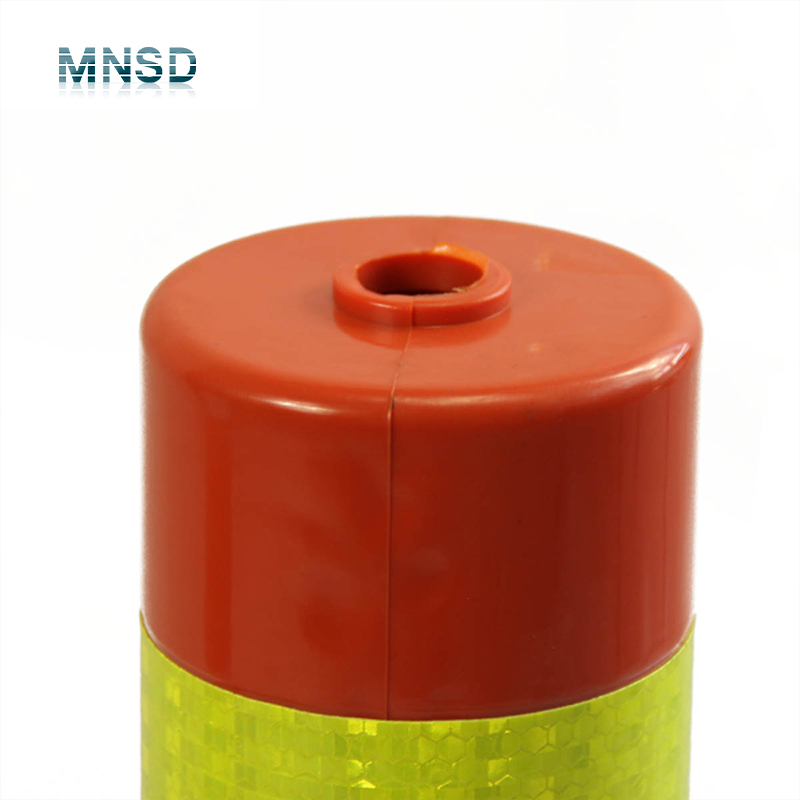
The YD-WP45 is made of high-elasticity polyurethane, with an overall height of 450 mm and a base size of 200×80 mm. Its published mechanical profile is 80–85 Shore A hardness, a tensile strength of 15.0 MPa and an elongation at break of 400%. Read together, those three numbers describe a material that is firm enough to stand upright under its own weight and wind load, yet stretches to several times its original length before it fails.
The behaviour that matters on site is the one described as self-recovery: rapid rebound after vehicle crush, combined with 360° flexibility and impact resistance. A post that bends but stays bent has failed just as surely as one that cracks, because the visual edge it was installed to create is gone. Hardness in the 80–85 Shore A band is the practical compromise — softer compounds flop and lose reflectivity alignment, harder compounds transfer more impact into the base.
2. The optics: how far and how clearly it reads
Visibility is a specification, not a slogan. The YD-WP45 uses High-Intensity Prismatic (HIP) / Class 1 reflective material in sleeves of 250 mm width, applied as double or triple sleeves, in silver white or fluorescent yellow, with a stated visibility distance of over 200 metres. The 250 mm sleeve width is what makes the post readable at distance; a narrow band reads well up close and poorly at speed.
3. The base and mounting: where flexible posts are won or lost
The standard installation for this model is expansion bolt fixing through 3 or 4 holes, which makes it a permanent, surface-mounted device rather than a portable one. In the UAE-style channelisation scenario the matching hardware is high-visibility reflective sleeves in a honeycomb pattern, M10/M12 heavy-duty expansion anchors, and optional epoxy adhesive for base reinforcement. Where a rubber base is preferred instead of bolting, the YD-PE50 uses a recycled rubber base with a Ø260 mm diameter.
The top detail is small but practical: a ring top allows a chain to be attached, which helps keep a delineation line continuous across a work zone and prevents posts from being displaced out of sequence.
4. The climate envelope
The published working range is −40°C to +70°C, with a UV-stabilised coating, anti-oxidant and colourfast performance stated as over three years, and water and oil resistance. That combination matters most in two environments: hot, high-UV markets where colour fade and chalking destroy contrast, and cold markets where a brittle compound shatters on first contact. Note the distinction between the two ageing figures published for this product family — over three years for colourfast performance on the product specification, and UV-stabilised colour fastness for five-plus years in the project scenario requirement. Buyers with a multi-year tender should confirm which figure the supplier is prepared to stand behind in writing.
Step-by-Step: Specifying a Flexible Warning Post
The sequence below is the order a buyer can follow without needing site test equipment.
- Name the traffic layer and the project type. Decide whether the post is doing channelisation, median delineation, pedestrian–vehicle segregation, or parking guidance. Each has a different consequence if the post is missing for a day.
- Choose the height against the geometry, not the catalogue. The range includes 450 mm (YD-WP45), 500 mm (YD-PE50) and 750 mm (YD-WPS75). Short posts suit tight, low-speed geometry where the driver is already slow; taller posts suit longer sight lines and higher approach speeds. Match the height to the approach, then confirm the base footprint fits the available surface.
- Fix the reflectivity grade. Specify HIP / Class 1 material, 250 mm sleeve width, double or triple sleeves, and choose silver white or fluorescent yellow to suit the background. Ask what visibility distance the supplier is claiming — over 200 metres for this family — and under what conditions.
- Decide the base interface. Bolted bases (3 or 4 holes, M10/M12 expansion anchors, optional epoxy) suit permanent installations on prepared concrete or asphalt. Rubber-base posts suit surfaces where drilling is not acceptable or where the line may need to be re-laid.
- Check the climate envelope against the site. Confirm the −40°C to +70°C range, UV stabilisation and the colourfast period in writing, and ask for the same data for any alternative material you are comparing.
- Collect the documents before the purchase order. For Mnsd, the Business License certification applies to the warning post manufacturer and the certification scope covers all items in the warning post business. Beyond that, project-level acceptance criteria come from the road owner, not the factory, so build a document checklist into the tender rather than assuming a supplier statement is sufficient.
Use Cases: Where the Middle Layer Earns Its Place
The published application range for this product family covers road traffic, parking lots, construction sites, industrial facilities, warehouses, logistics centres, airports, seaports, railway stations, schools, hospitals, commercial complexes, residential areas, highways, municipal engineering, public facilities, loading docks and bus terminals. Three of those deserve a closer look.
Highway and municipal channelisation
The reference scenario for this category is lane separation on high-speed expressways, highway ramps, T-junctions and urban sidewalk protection, installed surface-mounted or bolt-down as a permanent device. Here the post defines the edge of a merge or a pedestrian refuge where a rigid barrier would be wrong and paint would be invisible at night.
Parking structures and multi-level entrances
Multi-level car park entrances combine low speeds, tight radii and frequent contact. This is the classic case for a flexible post: a struck post rebounds, the driver reads the edge, and neither the slab nor the vehicle needs repair. Bolt-down fixing matters here because a loose base becomes a trip hazard in a pedestrian-shared area.
Industrial and logistics environments
Loading docks, warehouses and logistics yards involve forklifts and reversing vehicles with poor rear visibility. A delineator line at the edge of a pedestrian walkway gives drivers a continuous, replaceable visual cue. In these environments, oil and water resistance in the specification is not decorative — it is the difference between a readable sleeve and a stained one.
Comparison Table: Three Models in the Same Family
The table below compares only published specification data for three Mnsd warning post models. It is a fit table, not a ranking: the correct model is the one that matches the geometry, the surface and the climate of the site.
| Specification | YD-WP45 | YD-WPS75 | YD-PE50 |
|---|---|---|---|
| Overall size | 450×80×200 mm | 750×80×200 mm | 500×260 mm |
| Post material | High-elasticity PU (or heavy-duty PE) | High-elasticity PU (or heavy-duty PE) | Listed as PE with rubber base |
| Base | 200×80 mm | 200×80 mm | Recycled rubber base, Ø260 mm |
| Reflective grade | HIP / Class 1 | HIP / Class 1 | HIP / Class 1 |
| Reflective tape width | 250 mm (double or triple sleeves) | 250 mm (double or triple sleeves) | 250 mm (double or triple sleeves) |
| Visibility distance | 200+ m | 200+ m | 200+ m |
| Temperature resistance | −40°C to +70°C | −40°C to +70°C | −40°C to +70°C |
| Flexibility | 360°, impact resistant, rapid rebound after vehicle crush | 360°, impact resistant, rapid rebound after vehicle crush | 360°, impact resistant, rapid rebound after vehicle crush |
| Hardness / tensile / elongation | 80–85 Shore A / 15.0 MPa / 400% | 80–85 Shore A / 15.0 MPa / 400% | 80–85 Shore A / 15.0 MPa / 400% |
| Mounting | Expansion bolt, 3 or 4 holes; ring top | Expansion bolt, 3 or 4 holes; ring top | Rubber base; expansion bolt options listed |
| Colour options | Traffic orange / yellow / red / black | Traffic orange / yellow / red / black | Traffic orange / yellow / red / black |
| Typical fit | Low-speed, tight geometry; kerbs, refuges, car parks | Longer sight lines; approach roads, ramps, perimeter edges | Surfaces where a heavier rubber base is preferred over drilling |
Who makes the YD-WP45
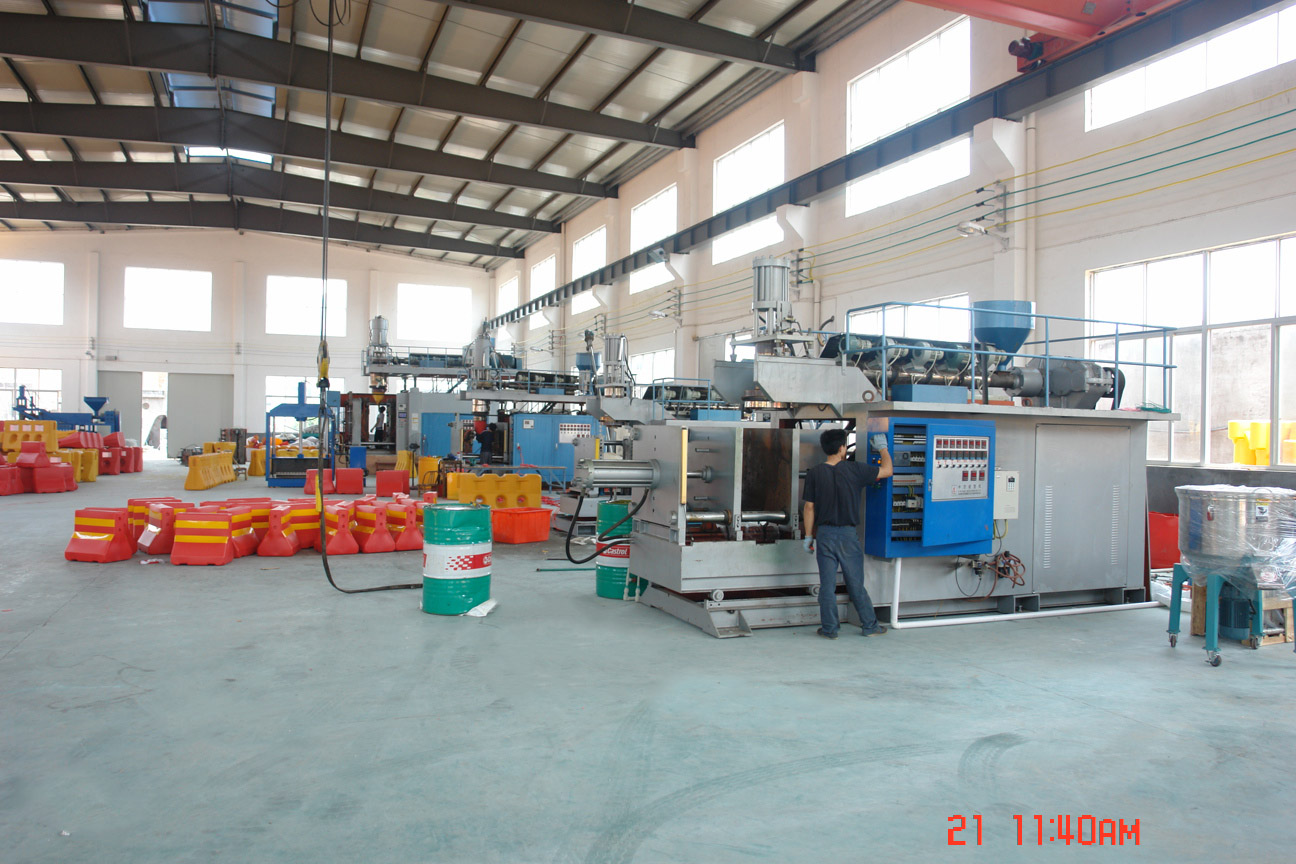
Mnsd is the brand of Tiantai Yuanda Traffic Device Co., Ltd., a road safety equipment manufacturer established in 2007 in Tiantai, Zhejiang, China. The company designs, produces and supplies traffic safety and parking safety products globally, with a core portfolio that includes convex mirrors, warning posts, rising bollards, speed humps and traffic lights. Its manufacturing facility covers 40,000 m² and is supported by approximately 300 staff, including an R&D team of 15 engineers, with an annual production capacity of 120,000,000 units. Export business accounts for 50% of total sales, with major markets in Asia, Europe and the USA.
FAQ
What documentation should a buyer check before specifying a flexible warning post?
Project acceptance criteria come from the road owner, not from the factory, so the first document to obtain is the applicable specification for that road or site. On the supplier side, Mnsd holds a Business License certification that applies to the warning post manufacturer, and the certification scope covers all items for the warning post business. Beyond certification, request the written product data: height and base dimensions, post material, reflective grade and sleeve width, claimed visibility distance, temperature range, and colourfast period. A supplier statement supports a shortlist; it does not replace the road authority’s own requirement.
How does a PU warning post recover after a vehicle drives over it?
Recovery is a function of the elastomer, not of a spring or hinge. The YD-WP45 is specified as 360° flexible and impact resistant, with self-recovery described as rapid rebound after vehicle crush. The supporting material data is 80–85 Shore A hardness, 15.0 MPa tensile strength and 400% elongation at break, which describes a body that deforms substantially before failure and returns to shape after the load is removed. A post that remains bent after impact has effectively been removed from the delineation line, which is why recovery — not just flexibility — is the property to specify.
Can a PU warning post stay outdoors all year?
The published working range for this product family is −40°C to +70°C, with a UV-stabilised coating, anti-oxidant and colourfast performance stated as over three years, and water and oil resistance. For a multi-year installation, ask the supplier to confirm in writing which colourfast figure applies to the specific model and market, because project scenario requirements in hot, high-UV regions are often stated as five-plus years of colour fastness, which is a longer commitment than the base product specification.
Which height should be specified: 450 mm, 500 mm or 750 mm?
Match the height to the approach geometry. The YD-WP45 is 450 mm high with a 200×80 mm base and suits tight, low-speed situations such as car park entrances, kerb lines and pedestrian refuges. The YD-PE50 is 500 mm with a Ø260 mm recycled rubber base, which suits surfaces where a weighted rubber base is preferred over drilling. The YD-WPS75 is 750×80×200 mm and suits longer sight lines on approach roads, ramps and perimeter edges. All three share the same reflective grade, temperature range and flexibility description, so height and base — not material grade — are usually the deciding variables.
How can buyers obtain specifications, a catalogue or a quotation?
Mnsd publishes a downloadable product catalogue and answers specification questions through its direct contact channels: info@mnsdtraffic.com and +86 18458137305, with the website at www.mnsdtraffic.com. Buyers comparing models should send the site type, the surface (concrete, asphalt or unsealed), the required height, the reflective colour and the climate range, so the reply maps to a real installation rather than a generic list.
Conclusion: The Middle Layer Is a Specification Decision
A flexible warning post is a simple object with an unsimple job. It has to be seen at over 200 metres, stand upright in heat and cold from −40°C to +70°C, bend under a bumper, and come back up. PU is the material that makes the third requirement realistic, which is why delineators in high-contact locations are usually specified in PU rather than in a rigid plastic. The Mnsd YD-WP45 illustrates the whole design logic in one 450 mm product: 80–85 Shore A hardness for stand-up stiffness, HIP / Class 1 reflective sleeves for distance reading, a bolted 200×80 mm base for a stable footprint, and rapid rebound for continuity after contact.
The practical takeaway for a first-time buyer is to stop treating the post as a commodity line item and start treating it as part of the traffic control layer structure. Decide which layer the post belongs to, size the height against the approach, fix the reflectivity grade, choose the base interface against the actual surface, and put the climate and colourfast commitments in writing. That sequence produces a specification that survives a tender review — and a delineation line that is still standing at the end of the season.
Next step: check the model against your site
The full Mnsd product range, dimensions and reflective options are set out in the catalogue, which can be downloaded here: Mnsd traffic safety product catalogue (PDF).
For a quotation or a specification check, contact the team at info@mnsdtraffic.com, by phone or WhatsApp on +86 18458137305, or through www.mnsdtraffic.com. Tiantai Yuanda Traffic Device Co., Ltd., hongsan industry zone, tiantai town, taizhou city, zhejiang province, china.
Have Questions or Need More Details?
Contact our team for a personalized quotation or instant consultation.
Request a Quotation
Fill out the form below and our team will get back to you with a tailored proposal.
WhatsApp Direct Chat
Prefer to chat in real-time? Message us on WhatsApp for instant assistance & quick answers.
- Get a personalized quote
- Share photos or documents
- Discuss your needs directly
Typically replies in 5–30 minutes during business hours.