
Convex Mirror Setup Guide: Warehouses vs. Parking Garages
An application-specific configuration guide for safety, procurement and facility teams specifying outdoor polycarbonate convex mirrors.
Warehouses and parking garages both hide sightlines, but they hide them differently — and that difference should decide which convex mirror you specify, how large it is, and how it is mounted. The working rule is simple: tight geometry such as racking aisles, cross-aisle intersections and garage ramps is served by a 600 mm or 750 mm outdoor polycarbonate convex mirror, where a compact footprint and a 15–25 m visual range are enough. Open factory floors, wide loading yards and long garage entry lanes call for 1000 mm or 1200 mm units, whose stated visual range reaches 30–45 m.
This guide compares the two environments step by step: what each one hides, which diameter closes the sightline, how pole and wall mounting differ, and which specification points a buyer should verify before ordering. The reference range used throughout is Mnsd's YD-OC series — YD-OC60, YD-OC75, YD-OC100 and YD-OC120 — built on a shared impact-resistant polycarbonate platform with a 130°+ wide-angle field, IP65 weatherproofing and mounting hardware sized for 60 mm and 75 mm poles.
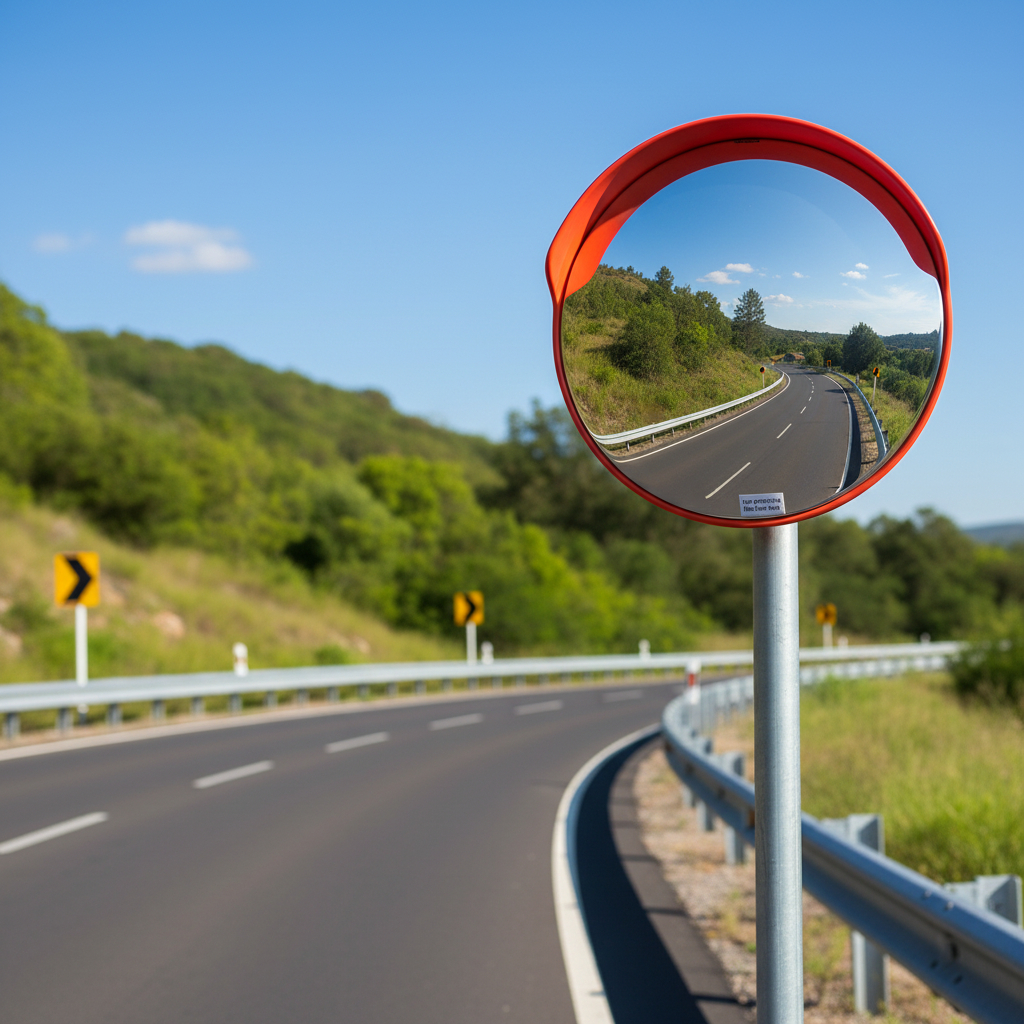
Problem Definition: Why One Mirror Size Cannot Serve Both Facilities
The visibility problem in a warehouse is angular. A forklift travelling down a racking aisle cannot see a second vehicle or a pedestrian approaching on a perpendicular cross-aisle until both are almost at the intersection. Loading dock doors create a second class of blind spot: a truck pulling out of a door has no view of the adjacent lane or of pedestrians crossing the apron. The sightlines that must be closed are short but sharply angled.
The visibility problem in a parking garage is both angular and vertical. Helical and straight ramps bring vehicles into conflict at the exact point where a driver's line of sight is compressed by the ramp wall and the ceiling structure. Column corners inside the parking bays repeat the same blind spot on every level, and pedestrian routes cross vehicle routes repeatedly.
Both environments therefore point to the same constraint rule: specify the mirror by the distance the sightline must travel, not by the size of the building. A single large site does not need a 1200 mm mirror in every aisle — it needs compact mirrors where sightlines are short and angled, and large mirrors only where the sightline is genuinely long and open.
Three constraints decide the outcome:
- Sightline length — what is the longest distance between two drivers who must see each other before the conflict point?
- Mounting surface — is there a 60 mm or 75 mm pole available, or must the mirror attach to a wall or structural column?
- Operating environment — dust, forklift impact risk, vehicle exhaust, unheated winter temperatures and UV exposure all change which specification point matters most.
A fourth constraint is often overlooked: scope of regulation. Convex mirrors fitted as supplementary devices on passenger cars in the United States fall under FMVSS No. 111, which sets a radius of curvature between 35 and 65 inches and requires the marking “Objects in Mirror are Closer Than They Appear”. Facility mirrors — the ones installed in warehouses and parking garages — are not governed by that rule. Their compliance conversation is about the enclosure instead: IP65 weatherproofing against dust and water jets, UV-stabilized polycarbonate and ABS, impact behaviour, and wind load resistance.
Industry Background: Where Safety Mirroring Sits in the Market
Demand behind these installations is not marginal. The global convex mirror market was valued at approximately USD 1.04 billion in 2025 and is projected to reach USD 1.73 billion by 2034, according to Dataintelo. Asia Pacific accounted for a 42.5% revenue share in 2025, and traffic and safety applications remain the largest single use segment, at 38.2% of the market.
Two signals sit alongside those numbers. General mirror demand has been soft — global trade in unframed mirrors fell 9.2% in 2023 compared with 2022, according to Business Research Insights — which reflects supply-chain shifts and weaker demand in general mirror products rather than in safety mirroring. Meanwhile, the applications driving the safety segment are precisely the ones covered in this guide: facilities where vehicles, pedestrians and restricted sightlines coexist.
Mnsd is the convex mirror brand of Tiantai Yuanda Traffic Device Co., Ltd., a road safety equipment manufacturer based in Tiantai, Zhejiang, China, whose product range covers convex mirrors, warning posts, rising bollards, speed humps and traffic lights, and whose products are exported to markets including Asia, Europe and the USA. The outdoor mirror range is built on polycarbonate rather than glass for one operational reason: an impact-resistant lens rated as vandal-resistant and self-recovery survives being struck far better than a shattered lens, which is a daily risk in forklift and vehicle environments.
Detailed Solution: The Mnsd Outdoor Polycarbonate Convex Mirror Platform
Mnsd's YD-OC series uses one shared specification platform across every diameter, which matters for buyers running both a warehouse and a garage portfolio: lens material, coating, weatherproofing and mounting hardware do not change when you change size. Only the diameter — and therefore the visual range — changes with the application.
Shared specification across the YD-OC range
- Mirror material: impact-resistant polycarbonate (PC), vacuum aluminium coated
- Lens thickness: 0.6–1 mm, customizable
- Curvature radius: R2200–R3000
- View angle: 130°+ wide-angle vision; the product scope field lists 180° panoramic coverage
- Backing: high-impact ABS backing, bright orange for high visibility, 2.0 mm back plate
- Mounting bracket: heavy-duty galvanized steel; fits 60 mm and 75 mm poles
- Temperature resistance: −30 °C to +80 °C
- UV protection: UV-stabilized PC and ABS, Grade 8 UV resistance, with a stated 3–5 year lifespan
- Weatherproof rating: IP65 for outdoor use
- Impact rating: vandal-resistant and self-recovery
- Wind resistance: Level 10 wind load resistant
- Optional: engineering-grade reflective tape on the rim; anti-scratch hard coating
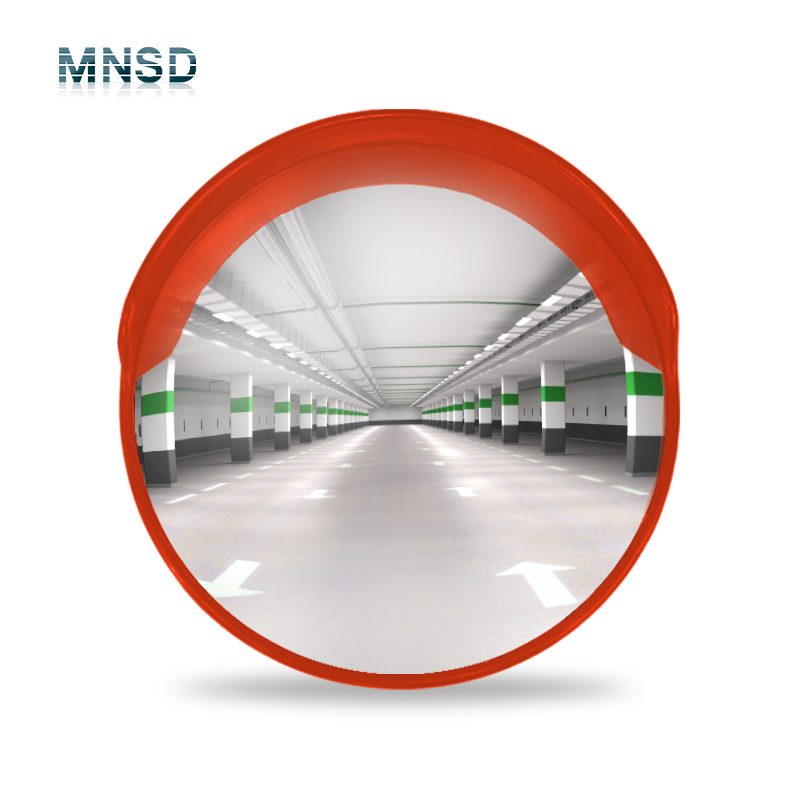
Sizing logic: diameter follows the sightline, not the building
Visual range is a function of diameter. A ⌀600 mm mirror (YD-OC60) covers 15–18 m; a ⌀750 mm mirror (YD-OC75) covers 20–25 m. Both remain compact enough for the angled, short sightlines found at the end of a racking aisle or on a single-lane garage ramp, where a large head would obstruct traffic or foul ceiling clearance.
Larger diameters take over when the sightline opens out. ⌀1000 mm (YD-OC100) covers 30–35 m and ⌀1200 mm (YD-OC120) covers 35–45 m — the range needed for a distribution centre's main cross-aisle, an open loading yard, or a long garage entry lane where vehicles approach from a distance at speed.
Mounting logic: poles in warehouses, walls and columns in garages
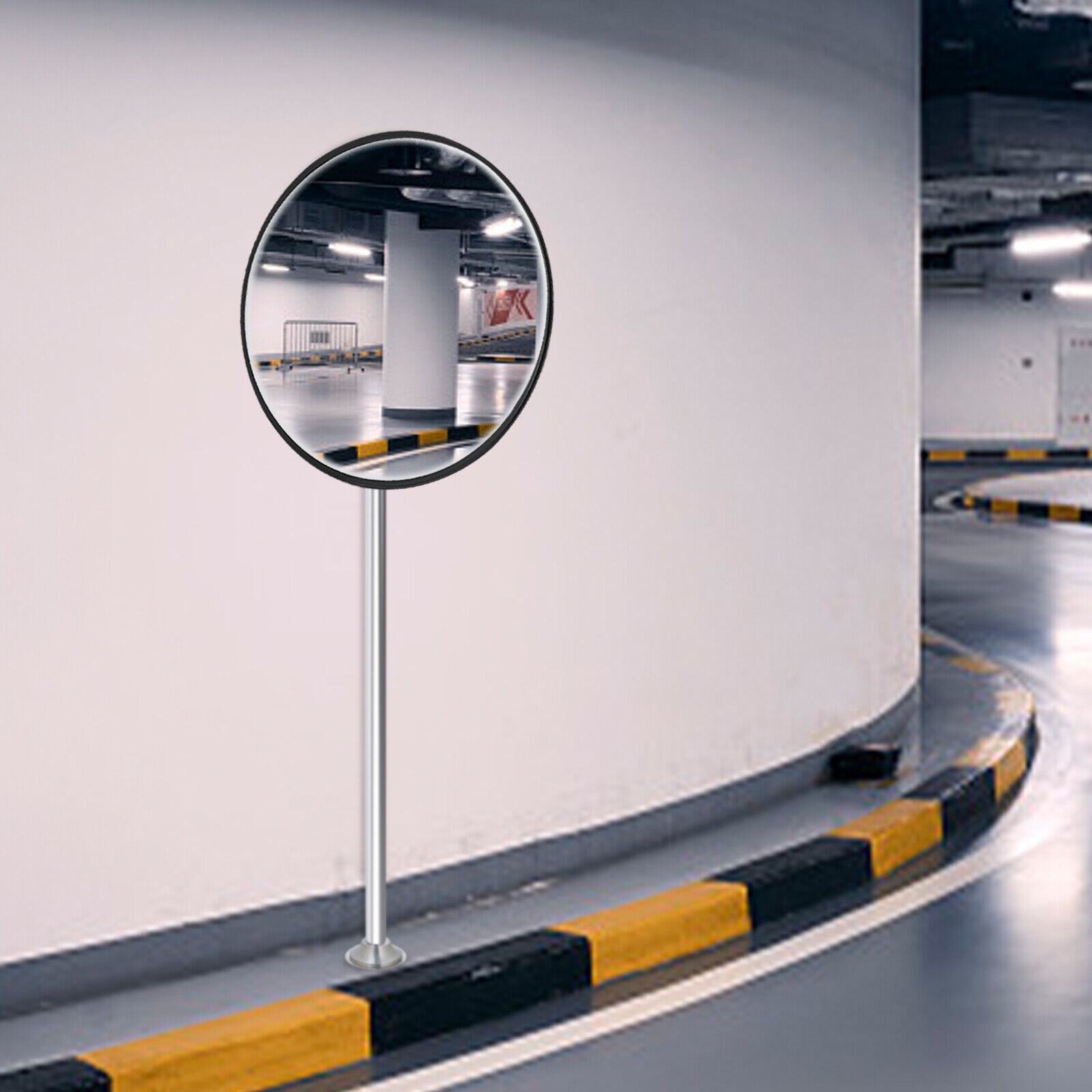
Poles are the default mounting surface in warehouses and outdoor logistics areas, and the YD-OC bracket is sized for 60 mm and 75 mm poles. In parking garages the equivalent fixing is usually a wall or a structural column, which is why the same mirror is catalogued with both wall-mounted and pole-mounted configurations. The optical part does not change — only the fixing method does.
Step-by-Step Breakdown: Configuring Mirrors for Each Environment
Step 1 — Define the sightline before choosing the mirror
Walk the site and identify who must see whom, and from how far. In a warehouse this is usually a forklift at an aisle end and a vehicle on the cross-aisle. In a garage it is a vehicle exiting a ramp and a vehicle already on the circulating lane. Note the physical structure at the conflict point — pole, column or wall.
Step 2 — Convert the sightline into a diameter
Match the measured distance to the stated visual range of the model, then choose the smaller option that still covers it. Aisles and single-lane ramps typically resolve to ⌀600 mm or ⌀750 mm; open floors and long yards resolve to ⌀1000 mm or ⌀1200 mm. Oversizing inside a confined aisle wastes budget and can create a new obstruction.
Step 3 — Match the mount to the structure
If a 60 mm or 75 mm pole exists or can be installed, use the galvanized steel pole bracket. If the only available surface is a wall or a garage column, specify the wall-mounted configuration. Confirm the surface can carry the unit's weight and wind loading before drilling.
Step 4 — Position the head at the conflict point
Mount the mirror so the reflected sightline lands where the approaching driver is already looking — at the corner or intersection itself, not behind it. In garages, keep the head clear of low ceiling structures and out of the direct path of vehicles; in warehouses, keep it above forklift and pedestrian height so it is not struck by passing loads.
Step 5 — Decide on rim and surface options
In dim areas such as unlit garages or night-time dock aprons, the optional engineering-grade reflective tape on the rim makes the mirror itself visible to approaching drivers. Where abrasive dust or cleaning is a factor, the optional anti-scratch hard coating protects the reflective surface over the stated 3–5 year lifespan.
Step 6 — Verify on site and schedule inspection
After installation, drive and walk the route to confirm the blind spot is closed. Then add the mirror to a simple inspection routine: check lens clarity, backing integrity and bracket tightness. Every Mnsd unit passes 100% impact and clarity inspection before leaving production, but site impacts and cleaning still determine service life.
Use Cases: Four Configurations That Cover Most Sites
Warehouse cross-aisle intersection
A racking aisle meeting a perpendicular cross-aisle is the classic ⌀600–⌀750 mm application. The mirror is wall- or pole-mounted at the aisle end, with the 130°+ wide-angle field covering both approach directions. Compact size keeps it clear of forklift and pallet traffic.
Warehouse loading dock
Dock aprons combine reversing vehicles, yard traffic and pedestrians, and the sightline from a dock door to the adjacent lane is longer than an aisle. ⌀750 mm covers short aprons; where the yard opens out, ⌀1000 mm is the more practical choice because it delivers 30–35 m of visual range.
Parking garage ramp and column corner
Ramps and column corners repeat on every level, so consistency matters more than individual optimization. A ⌀600–⌀750 mm unit fixed to the ramp-side wall or column covers the exit conflict; ⌀800 mm suits mid-bay corners where the approach distance is slightly longer.
Distributor project reference: road corners and parking blind spots
In Thailand, a distributor supplying a medium-sized traffic safety project used Mnsd convex mirrors to improve visibility at road corners and parking blind spots. The units were delivered on time and passed local acceptance, with wide viewing angle, weatherproofing and durability cited as the deciding characteristics, and a project service life of 5–8 years. That combination — angled sightlines plus outdoor exposure — is the same brief a warehouse or garage upgrade presents.
Comparison Table: Diameter, Visual Range and Best-Fit Environment
| Model | Diameter | View angle | Stated visual range | Typical best-fit deployment |
|---|---|---|---|---|
| YD-OC45 | ⌀450 mm | 130°+ (scope: 180°) | 10–12 m | Short internal corridors, tight garage corners, pedestrian-only junctions |
| YD-OC60 | ⌀600 mm | 130°+ (scope: 180°) | 15–18 m | Warehouse aisle ends, single-lane garage ramps |
| YD-OC75 | ⌀750 mm | 130°+ (scope: 180°) | 20–25 m | Cross-aisle intersections, dock approaches, ramp merges |
| YD-OC80 | ⌀800 mm | 130°+ (scope: 180°) | 22–28 m | Mid-size aisles, garage entry lanes, mid-bay column corners |
| YD-OC100 | ⌀1000 mm | 130°+ (scope: 180°) | 30–35 m | Open factory floors, wide loading yards, distribution cross-aisles |
| YD-OC120 | ⌀1200 mm | 130°+ (scope: 180°) | 35–45 m | Open yards, long lanes, large warehouse ends |
Warehouse vs. parking garage: configuration matrix
| Decision factor | Warehouse (aisles, docks) | Parking garage (ramps, corners) |
|---|---|---|
| Dominant blind spot | 90° racking intersections and dock doors | Ramp exits, helical ramps, column corners |
| Sightline to close | 15–25 m inside aisles; up to 45 m on open floors | 15–25 m on ramps; 22–28 m at mid-bay corners |
| Recommended diameter | ⌀600–⌀750 mm in aisles; ⌀1000–⌀1200 mm across open floors | ⌀600–⌀750 mm on ramps; ⌀800 mm at mid-bay corners |
| Mounting | 60 mm / 75 mm pole or wall bracket | Wall or column fixing; pole at ramp entries |
| Environment constraint | Dust, forklift impact, pallet handling | Vehicle exhaust, low light, unheated winter conditions |
| Spec to verify first | Impact rating (vandal-resistant, self-recovery) and IP65 housing | IP65, −30 °C to +80 °C temperature band, Grade 8 UV resistance |
FAQ: Configuring Convex Mirrors for Warehouses and Garages
Do warehouse and parking garage convex mirrors need the same certification as vehicle mirrors?
No. FMVSS No. 111 applies to convex mirrors supplied as supplementary devices on passenger cars in the USA, setting a radius of curvature between 35 and 65 inches and requiring the marking “Objects in Mirror are Closer Than They Appear”. Facility mirrors installed in warehouses and parking garages fall outside that scope. For facility installations, the verifiable specification points are the enclosure and material properties: IP65 weatherproofing for outdoor use, a −30 °C to +80 °C operating range, UV-stabilized PC and ABS with Grade 8 UV resistance, a vandal-resistant and self-recovery impact rating, and Level 10 wind load resistance.
Can the mirrors be customized to a specific diameter, backing or mounting structure?
Yes. Mnsd offers OEM/ODM manufacturing with customization across diameter (45–120 cm), backing material (PP, ABS or fibreglass) and lens (PC or stainless steel), in addition to the standard YD-OC45 to YD-OC120 range. Production capacity is 30,000 pieces per month with 100% impact and clarity inspection on every unit, and export markets include Europe, North America and Southeast Asia. This matters when a garage column fixing or a non-standard aisle width does not match a catalogue configuration.
What drives the cost of a convex mirror specification?
Four variables dominate. The first is diameter, because it determines the polycarbonate lens area and the backing size. The second is material selection for the backing and lens, since ABS, PP and fibreglass backings and PC or stainless steel lenses are priced differently. The third is optional features — engineering-grade reflective tape on the rim and an anti-scratch hard coating. The fourth is order and freight economics: the minimum order quantity is 100 pieces, and a 20 ft container is the standard shipment unit, so consolidating a mixed-diameter order across several sites usually improves the landed cost per mirror.
How should a buyer validate a mirror before ordering for a full site rollout?
Validate against the constraint list rather than the photograph. Confirm the stated visual range against the measured sightline at the actual conflict point; check that the bracket fits the 60 mm or 75 mm pole you have, or that a wall-mounted configuration suits the column; confirm the IP65 rating and the −30 °C to +80 °C temperature band if the site is unheated; and check the lens clarity and orange ABS backing visibility from the driver's approach angle. If the site is dim, validate whether rim reflective tape is needed. A single-unit validation on the worst-case blind spot is the most useful test before a multi-level rollout.
What is the lead time, and how do we start?
Standard lead time is 15–20 days for a 20 ft container, with a minimum order quantity of 100 pieces and a monthly production capacity of 30,000 pieces. To start, share the site type (warehouse aisle, dock, garage ramp or corner), the sightline distance at each conflict point, and the available mounting surface. Mnsd will map those inputs to a diameter, mounting configuration and optional features, and can arrange a sample or a quotation for validation before the full order.
Conclusion: Match the Mirror to the Geometry, Not the Building
Warehouse aisles and parking garages look like the same problem, but they are not. Warehouses hide short, sharply angled sightlines at racking intersections and dock doors; garages hide short sightlines plus repeated column corners and ramp merges. In both cases the diameter should follow the distance the sightline must travel. A ⌀600 mm or ⌀750 mm Mnsd YD-OC60 or YD-OC75 closes angled aisle and ramp conflicts at 15–25 m. A ⌀1000 mm or ⌀1200 mm YD-OC100 or YD-OC120 covers open floors and long lanes at 30–45 m. Every model shares the same platform: impact-resistant polycarbonate with vacuum aluminium coating, 130°+ wide-angle vision, IP65 weatherproofing, UV-stabilized PC and ABS, a −30 °C to +80 °C range, and a heavy-duty galvanized steel bracket sized for 60 mm and 75 mm poles.
Specify by sightline, mount by available structure, and verify on site — that sequence produces a mirror layout that works in both environments without oversizing either one.
Planning a mirror layout for a warehouse, a parking garage or both? Send us your site type, sightline distances and available mounting surfaces, and Mnsd will match each conflict point to a diameter and mounting configuration.
Request a quote or a validation sample: info@mnsdtraffic.com · WhatsApp +86 184-5813-7305 · www.mnsdtraffic.com
Download the full product catalogue: Mnsd traffic safety equipment brochure (PDF)
Mnsd is the convex mirror brand of Tiantai Yuanda Traffic Device Co., Ltd., Tiantai, Zhejiang, China — a road safety equipment manufacturer supplying importers, distributors, contractors and project suppliers.
Have Questions or Need More Details?
Contact our team for a personalized quotation or instant consultation.
Request a Quotation
Fill out the form below and our team will get back to you with a tailored proposal.
WhatsApp Direct Chat
Prefer to chat in real-time? Message us on WhatsApp for instant assistance & quick answers.
- Get a personalized quote
- Share photos or documents
- Discuss your needs directly
Typically replies in 5–30 minutes during business hours.