
Selecting Warning Posts for Construction Sites: Site Adaptation and Installation Insights
Construction sites rarely look the same two weeks in a row. The warning posts that work on a finished road often fail in a work zone, because the boundary moves, the surface is unfinished, and delivery vehicles brush the line every day. This guide covers how flexible warning posts, including Mnsd's YD-WP45 and YD-WPS75 models, are adapted to construction conditions and installed so they keep working after contact.
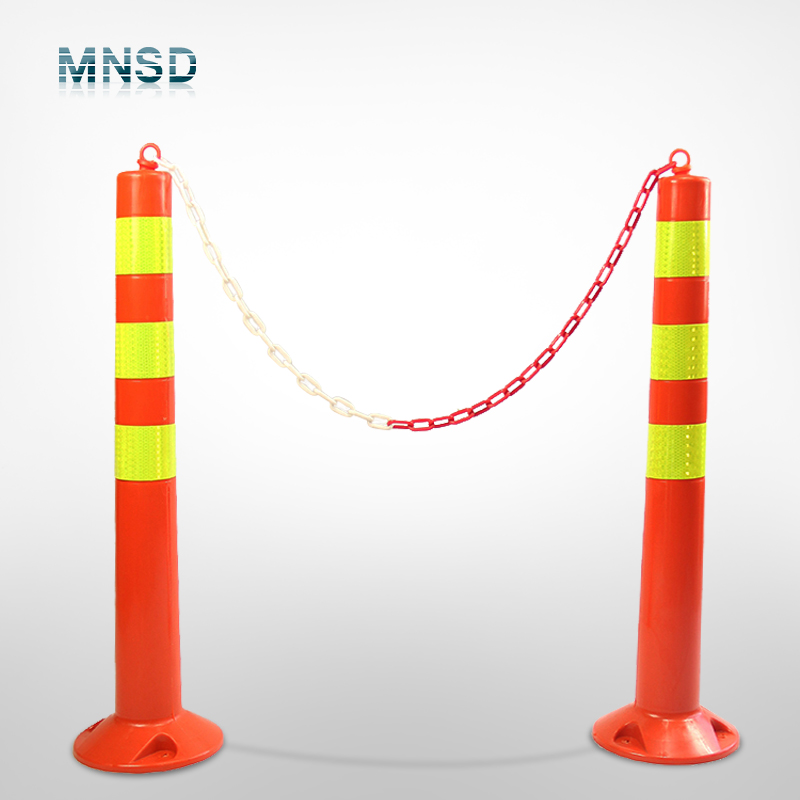
Mnsd 75cm flexible warning post — the same flexible, reflective design principle used across the YD-WP45 and YD-WPS75 models.
Mnsd is the brand of Tiantai Yuanda Traffic Device Co., Ltd, a road safety equipment manufacturer based in the Hongsan industry zone, Tiantai town, Taizhou city, Zhejiang province, China. The company serves importers, distributors, wholesalers, contractors, and infrastructure project suppliers worldwide, and its product range covers warning posts, convex mirrors, speed humps, rising bollards, and traffic lights.
Within that range, the warning post is the simplest item and one of the hardest working on a construction site. A permanent road edge stays where it is drawn. A work zone does not. Traffic routes shift as work fronts advance, the surface underfoot may be gravel, milled asphalt or freshly poured concrete, and the people crossing the line are a mix of plant operators, delivery drivers, and pedestrians walking to the site office.
This article deals with the selection and installation of warning posts specifically for construction zones. It uses Mnsd's YD-WP45 and YD-WPS75 flexible warning posts as working examples and stays inside verified product features: weatherproof construction, resistance to water and oil, expansion bolt fixing through a base with three or four holes depending on the model, and a ring-top design that allows posts to be chain-linked into a continuous perimeter line.
Why Construction Zones Break the Assumptions Behind Standard Warning Posts
On a finished road, a delineator post has one job and one environment. In a construction zone, the same product is asked to handle four conditions at once:
- Repeated low-speed contact from plant, delivery vehicles and pallet trucks working close to the boundary.
- Marginal visibility caused by dust, low light, and headlights reaching the line at a shallow angle.
- Surfaces that change as work progresses, so a post fixed for one layout may have to be moved for the next.
- Chemical and weather exposure including washout water, fuel and hydraulic oil around plant, plus UV and sustained heat.
Rigid hardware fails differently in each case. A rigid post struck by a reversing truck either bends permanently, leaves a stub that is itself a hazard, or pulls out of its fixing and takes a section of the boundary with it. A post that is only readable in daylight stops working at dusk. A post fixed by a method that suits only one surface cannot follow the work front as it advances.
Visibility expectations are not a matter of opinion. The Manual on Uniform Traffic Control Devices (MUTCD) requires delineators to be retroreflective and visible from 1,000 feet when illuminated by high-beam headlights. In Europe, EN 12899-3 specifies requirements for delineator posts and retroreflectors used in traffic circulation areas. Neither document names a specific product, but together they give a contractor a defensible benchmark to write into a site specification.
Industry Background: Where Warning Posts Sit in the Traffic Safety Market
The road marker posts market was valued at USD 3.4 billion in 2024 and is projected to reach USD 5.4 billion by 2032, according to Road Marker Posts Market Size Analysis. Dataintelo projects the broader traffic safety products market to expand at a CAGR of 6.6% between 2026 and 2034, driven by urban population growth and infrastructure investment.
Two shifts matter for construction buyers. The first is volume: more urban and infrastructure work means more temporary work zones that need delineation on a short cycle, with hardware that can be deployed and recovered quickly. The second is material choice. According to the OPTRAFFIC Material Guide, Thermoplastic Polyurethane (TPU) is preferred for high-impact warning posts because of its elastic recovery and durability compared with standard Polyethylene (PE). For a specifier, that comparison translates into one question — how much impact recovery does this particular site actually require?
Standards give buyers a way to test claims rather than accept them. ASTM D2765 provides standard procedures for measuring gel content and swell ratio of crosslinked ethylene plastics used in industrial safety products, which is useful when documented material data is required for a PE-based component. EN 12899-3 covers delineator posts and retroreflectors in European traffic circulation areas. Mnsd works with rubber, PE and PVC across its traffic safety range and offers OEM and ODM customization services for buyers who need a specification matched rather than a catalogue item chosen.
How Mnsd Warning Posts Are Adapted to Construction Zone Conditions
Two models on the same design principle
Mnsd's flexible warning post range includes the YD-WP45 and YD-WPS75. Both are flexible, reflective posts intended for environments where vehicles and pedestrians share space — road traffic, residential quarters, parking garages, factories and warehouses, logistics parks, schools, hospitals, and construction sites. The two models give a contractor two points on the same design principle: a post that bends and returns rather than resisting and breaking, fixed to the ground where the line is semi-permanent, and handled or moved where the layout changes daily.
Weatherproof construction and resistance to water and oil
The warning posts are built with weatherproof construction and surfaces that resist water and oil. On a construction site, that is not a minor detail. Washout from concrete, standing water at haul road edges, and fuel or hydraulic fluid around plant refuelling points all reach the base and lower body of a post. The reflective sleeve, not the post itself, is what makes the post work after dark — once contamination dulls or lifts the reflective surface, the post becomes a physical obstacle with no warning function.
Expansion bolt fixing with three or four holes
Where a boundary needs to hold for weeks or months, the base of the warning post is fixed with expansion bolts through pre-formed holes — three or four holes depending on the model. A bolted base gives two advantages in an active work zone: the post resists being pushed off line by repeated low-speed contact, and the fixing point stays predictable when a reflective sleeve is replaced or a damaged post is swapped out. Expansion bolt fixing suits concrete and asphalt, the two surfaces most common at site gates, haul roads and finished hardstanding.
Ring-top design and chain linking for perimeter control
The ring top changes how a construction boundary is built. Each post carries a ring at the top of the body, and crews can pass chain or rope through the rings to link individual posts into a continuous line. On site, that turns a set of separate markers into a working perimeter: the line has a visual component from the reflective posts and a physical component from the chain. Because each post flexes on contact, the linked line absorbs a hit from a vehicle or a pallet truck and returns to position instead of tearing the fixings out of the ground.
Ring-top chaining is also the quickest way to reconfigure. Extending an exclusion zone around a new work front, or temporarily closing a gate, means adding or unhooking a chain rather than re-drilling a post line.
Impact recovery, cost position and maintenance
Flexible warning posts are designed to rebound after contact, are impact-resistant, and consume no energy. No power supply is needed, which is a practical point on sites without reliable temporary power. Maintenance is limited to cleaning the reflective surface and replacing a post that has been damaged beyond recovery. On cost, warning posts sit at the low end of traffic control hardware — they are cheaper than guardrails and barriers, which makes it realistic to deploy them at the spacing a construction boundary needs rather than rationing them.
Heat and dimensional stability
High temperatures are a genuine risk for plastic posts. Mnsd addresses it through heat resistance analysis: wall thickness is optimised to prevent sagging in high-temperature climates, with material stability up to 60°C. In hot climates this belongs in the sample check rather than in a complaint after delivery, because a post that sags loses both its profile and its ability to be chain-linked.
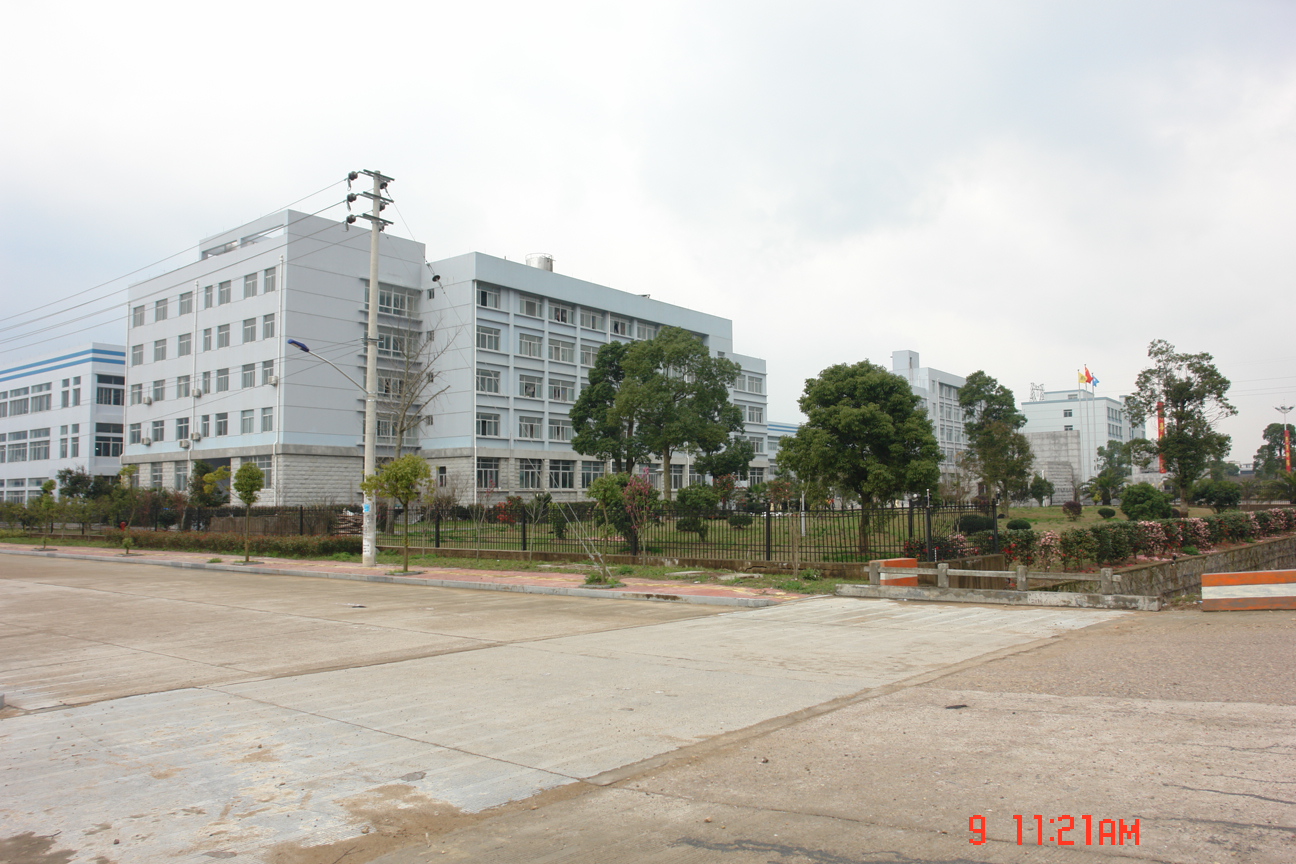
Mnsd's traffic safety manufacturing base supplies warning posts alongside convex mirrors, speed humps, rising bollards and traffic lights.
Step-by-Step: Installing Warning Posts on an Active Construction Site
The sequence below follows the order that avoids rework. Doing step two before step one is the most common cause of a boundary that has to be rebuilt twice.
- Map what each line has to do. Walk the site and label every line by function: exclusion boundary around an excavation or crane zone, traffic route for delivery vehicles, pedestrian route between the gate and the site office, or protection of a finished surface. A line that separates people from plant has a different tolerance for contact than a line marking a parking edge.
- Choose the fixing method before the model. If the line will hold for weeks or months on concrete or asphalt, expansion bolt fixing through the three- or four-hole base is the stable choice. If the layout changes with the work front, plan for a movable section and keep bolted posts for the parts of the boundary that do not move.
- Set out the line with the reflective band facing approaching traffic. A reflective post is directional in practice — the band has to face the direction from which vehicles and pedestrians approach. Keep the run as straight as the layout allows so that a linked chain stays taut.
- Fix the base. Drill and set the expansion bolts through the pre-formed holes in the base, keeping the post vertical. Verify that the base is fully seated and that the post cannot be rocked by hand before moving to the next position.
- Link the ring tops. Pass chain or rope through the top rings to close the perimeter. Linking is what converts individual posts into a boundary that a driver reads as continuous rather than as a series of separate objects.
- Verify visibility after dark. Check the finished line with headlights at night. The MUTCD benchmark of visibility from 1,000 feet under high-beam headlights is a useful reference for how the line should read from a vehicle, and site dust will lower that performance over time.
- Check the post under sustained heat. On hot-climate sites, confirm that the profile stays straight through the hottest part of the day and that material stability up to 60°C is adequate for local conditions.
- Set an inspection and reorder cycle. Clean reflective surfaces on a fixed schedule, inspect after any vehicle contact, and replace only posts that no longer recover. Mnsd's production uses high-speed injection molding with a monthly capacity of 50,000 pieces, and bulk orders typically ship in 10 to 15 days, so reorders can be planned against the site programme rather than triggered by a shortage.
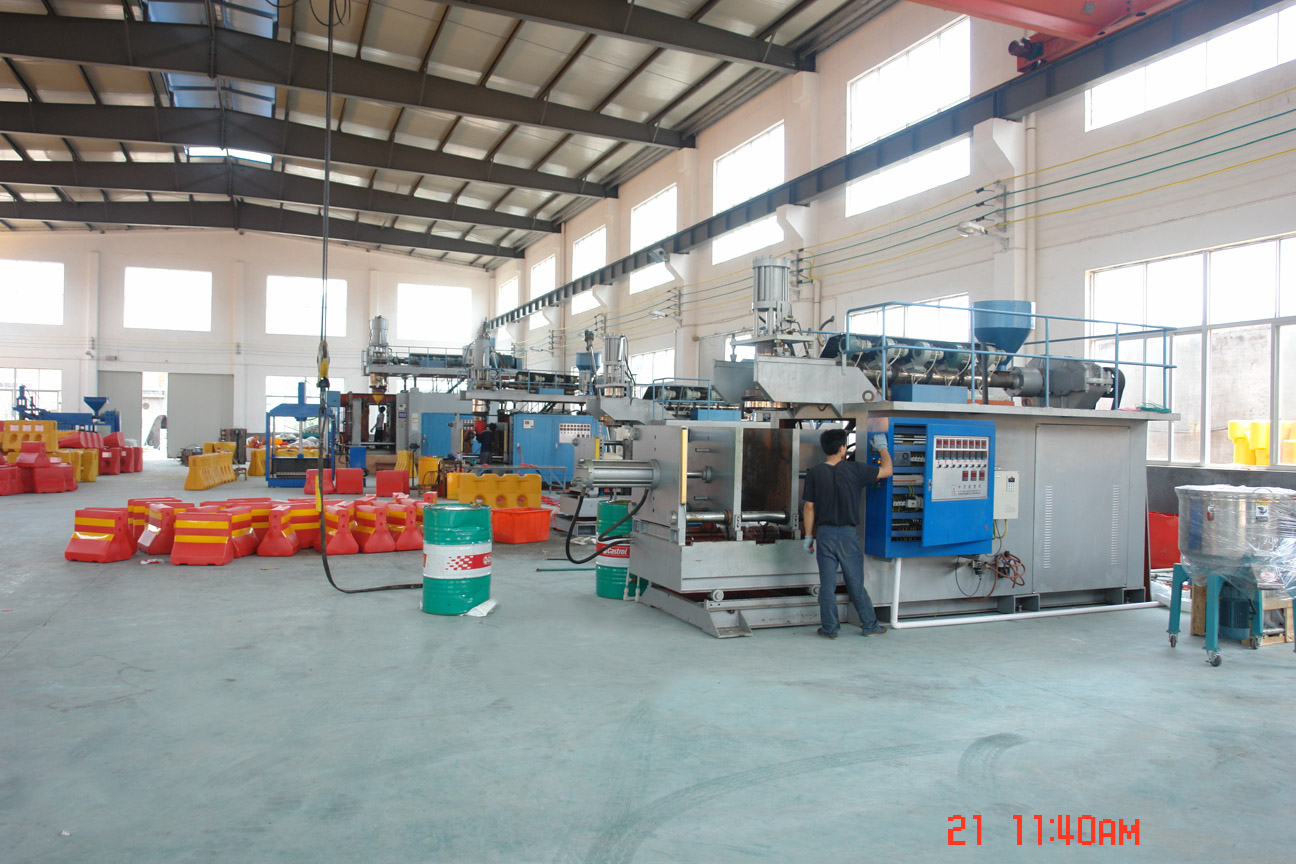
Plastic product line at Mnsd — warning post bodies are produced by high-speed injection molding.
Construction Site Use Cases
1. Perimeter control around an excavation or crane zone
Ring-top posts linked with chain create a continuous boundary that can be extended as the work front moves. Because the posts flex, plant working close to the line can brush it without destroying the boundary or leaving a bent stub inside the exclusion zone.
2. Gate and delivery lane channelization
At the site gate, the problem is turning vehicles with poor rear visibility. A bolted line of flexible posts on both sides of the route keeps the lane readable for drivers entering and leaving, and absorbs contact from vehicles that clip the edge. Where the route is re-cut as work progresses, the same posts can be lifted and re-set.
3. Separating pedestrian routes from plant movement
Walking routes between the gate, the site office and the work front cross vehicle paths. A flexible post line with high-visibility reflection separates the two without introducing a hard obstacle — the same flexibility that protects the post also reduces injury risk for a pedestrian who collides with it.
4. Protecting newly finished surfaces
Freshly poured concrete and new paving are damaged by vehicles cutting across them. A bolt-fixed warning post line through the pre-formed base holes marks the protected area, stays stable under repeated contact, and is removed cleanly when the surface is ready for use.
5. Hot-climate and fuel-exposed sites
Two conditions deserve separate attention. In hot climates, the profile must resist sagging, which is why wall thickness and material stability up to 60°C matter. Around refuelling points and plant parking, water and oil resistance in the post surface determines how long the reflective sleeve stays functional.
Matching Configuration to Site Zone
| Site zone | Configuration | Fixing method | Why it fits |
|---|---|---|---|
| Outer perimeter / exclusion zone | YD-WP45 or YD-WPS75 linked with chain through the ring top | Expansion bolts into hardstanding; movable posts where the line shifts | Continuous visual and physical boundary; flexible rebound absorbs plant contact |
| Gate and delivery lane channelization | Flexible reflective warning posts run along both sides of the route | Expansion bolts | Keeps the route readable for entering and leaving vehicles; resists being clipped by turning vehicles |
| Pedestrian route beside plant movement | Flexible posts with high-visibility reflection | Bolted or movable, depending on duration | Separates people from plant without creating a hard obstacle; no energy consumption |
| Newly finished surfaces (concrete, paving) | Bolt-fixed warning post line | Expansion bolts through the pre-formed base holes | Protects the surface while keeping the line stable; almost maintenance-free |
| Hot-climate sites | Warning posts with optimised wall thickness | Expansion bolts | Material stability up to 60°C prevents sagging in the profile |
| Refuelling and plant parking points | Warning posts with water- and oil-resistant surface | Bolted or movable | Reflective sleeve keeps working when fuel and oil contamination is present |
Configuration matrix based on Mnsd product features and the site conditions each flexible warning post design is intended to handle.
FAQ
What purchasing terms and acceptance criteria apply to a bulk warning post order?
Mnsd works to a minimum order quantity of 100 units, with delivery terms of FOB or CIF. Acceptance is based on a pre-shipment test, and payment terms are 30/70. Because acceptance criteria are applied to the order as specified, model, base hole pattern, reflective band and packing should be confirmed before the pre-shipment test is carried out.
Can warning posts be adapted to a specific site or to a distributor's own range?
Yes. Mnsd offers OEM and ODM customization services across its traffic safety range, which includes warning posts, convex mirrors, speed humps, rising bollards and traffic lights, and works with materials such as rubber, PE and PVC. The company serves importers, distributors, wholesalers, contractors, and infrastructure project suppliers worldwide. For construction applications, the points most often discussed at specification stage are the base fixing pattern, the model itself, and the reflective treatment.
What drives the cost of a warning post programme across a construction site?
Two factors dominate. The first is unit cost: flexible warning posts are cheaper than guardrails and barriers, so a project can afford to deploy them at the spacing the boundary needs. The second is lifetime cost: the posts need no power, consume no energy, and require almost no maintenance beyond cleaning and replacing a post that has been damaged beyond recovery. The direct minimum order quantity from Mnsd is 100 units.
How should a buyer validate a warning post before committing to a bulk order?
Mnsd's acceptance criteria for an order are based on a pre-shipment test. At sample stage, the checks that matter for construction use are the same ones that matter on site: whether the post returns upright after being bent, whether the reflective band is clean and correctly oriented, whether the base hole pattern matches the fixing method planned for the site, and whether the profile stays straight under sustained heat, given material stability up to 60°C.
What lead time should be planned, and how do long-term buyers keep supply continuous?
Production uses high-speed injection molding, and Mnsd's monthly production capacity is 50,000 pieces. For bulk orders, the typical lead time is 10 to 15 days. Buyers who place recurring orders across multiple projects — importers, distributors, wholesalers, contractors and infrastructure project suppliers — plan against the site programme rather than against a single delivery. A road safety project in Vietnam utilizing this product was completed and accepted by local authorities. To move forward, request the Mnsd catalogue and a quotation, or ask for a sample for site validation, at info@mnsdtraffic.com or through WhatsApp at +86 184-5813-7305.
Conclusion: Delineation Is a Maintenance Problem, Not Just a Hardware Choice
Construction site delineation is a maintenance problem disguised as a hardware problem. Posts that break on contact, lose their reflective surface, or cannot follow a moving work front create work for site crews and, more seriously, gaps in the boundary. Flexible warning posts address that by combining a reflective, weatherproof body with a base that can be bolted down through three or four pre-formed holes, and a ring top that lets a crew chain individual posts into a perimeter they can extend or close in minutes.
For buyers at the decision and execution stage, the checklist is short and practical. Confirm the base fixing method against the actual surface. Confirm the post recovers after impact and stays straight at local temperatures, up to 60°C where relevant. Confirm the reflective band will survive water, oil and dust. Then confirm supply — minimum order quantity, lead time and production capacity — so the boundary does not depend on a single delivery going to plan.
Next Step: Sample, Quotation or Catalogue
Mnsd supplies flexible warning posts, convex mirrors, speed humps, rising bollards and traffic lights to importers, distributors, wholesalers, contractors and infrastructure project suppliers worldwide. For construction site projects, you can request a sample for site validation, a quotation against your own configuration, or the full product catalogue.
Download the catalogue: Mnsd Product Brochure (PDF)
Website: www.mnsdtraffic.com
Email: info@mnsdtraffic.com
WhatsApp: +86 184-5813-7305
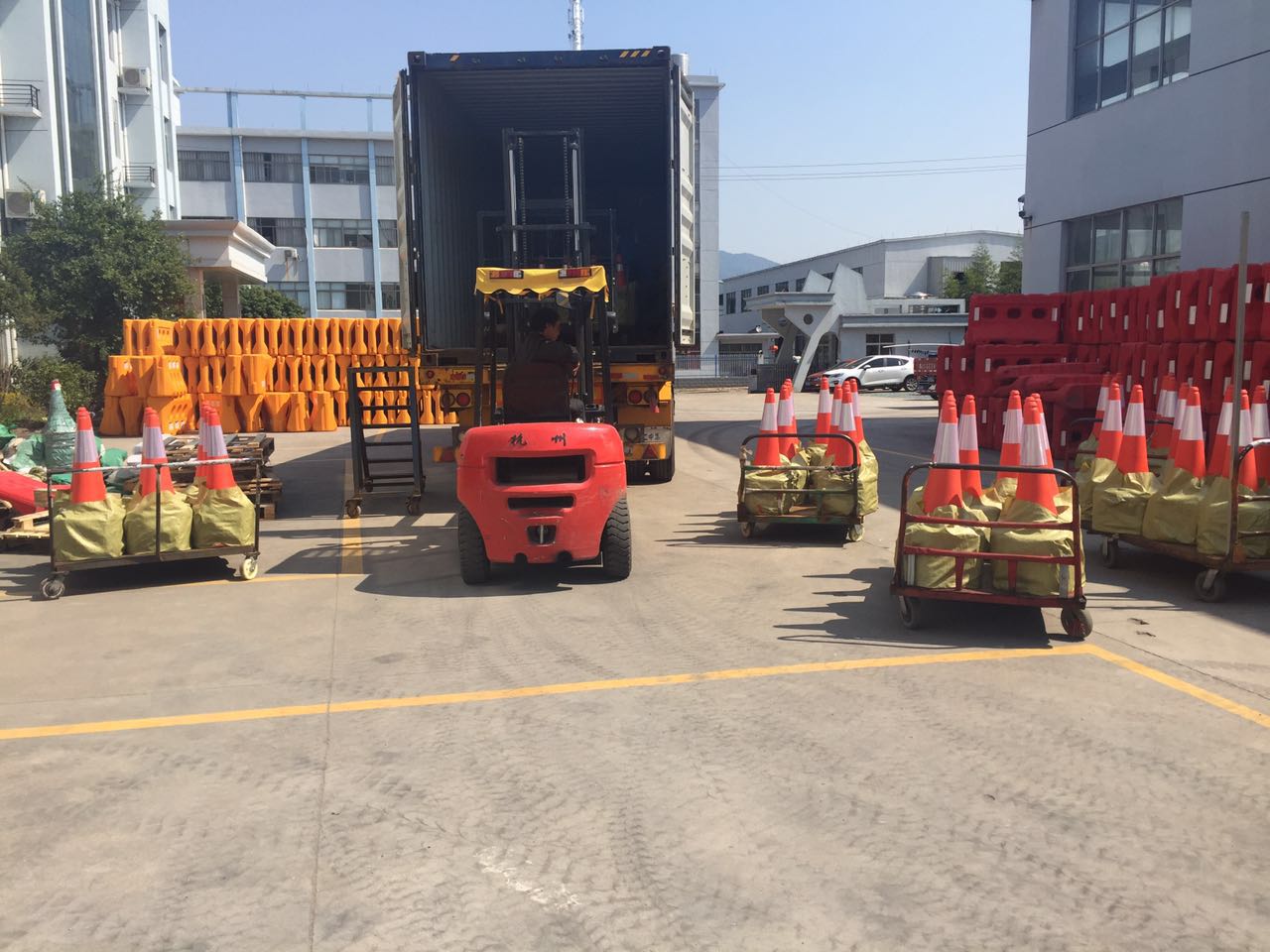
Dispatch and loading area at Mnsd — bulk order lead time is typically 10 to 15 days, with monthly capacity of 50,000 pieces.
Have Questions or Need More Details?
Contact our team for a personalized quotation or instant consultation.
Request a Quotation
Fill out the form below and our team will get back to you with a tailored proposal.
WhatsApp Direct Chat
Prefer to chat in real-time? Message us on WhatsApp for instant assistance & quick answers.
- Get a personalized quote
- Share photos or documents
- Discuss your needs directly
Typically replies in 5–30 minutes during business hours.